Few-Shot Learning for PPG: Personalizing Models with Minimal Calibration Data
Few-shot learning adapts a PPG model to a new user, new device, or new clinical condition using only 5-30 labeled examples. Where standard supervised ...
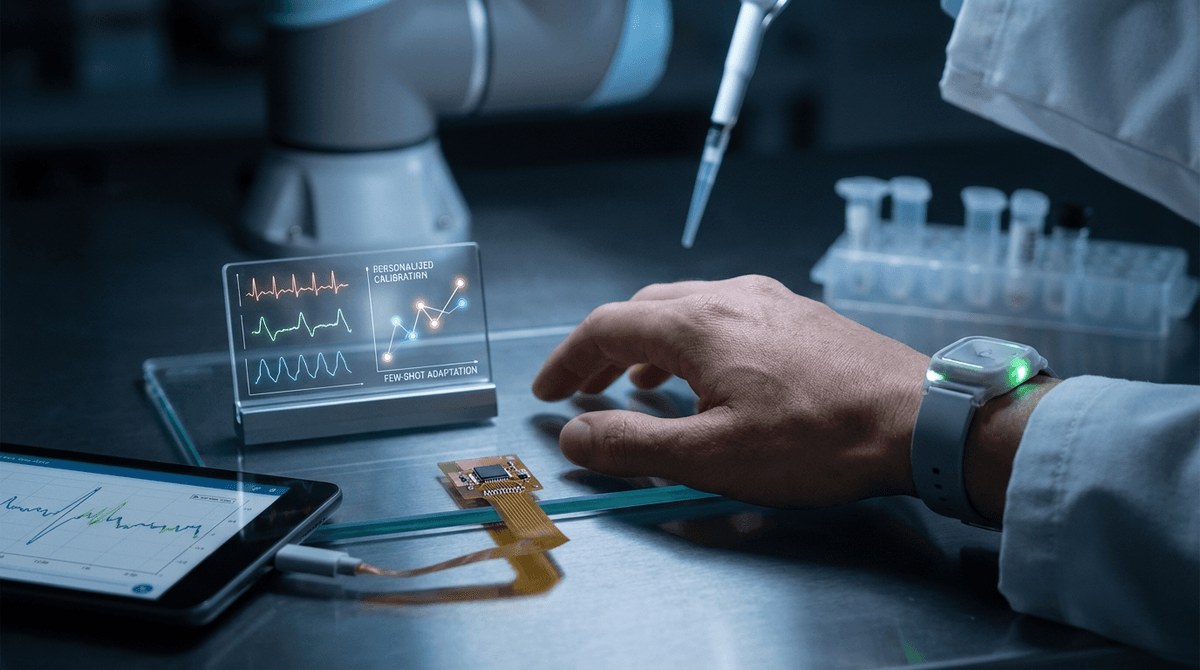
Few-shot learning adapts a PPG model to a new user, new device, or new clinical condition using only 5-30 labeled examples. Where standard supervised learning needs hundreds of labeled samples to generalize reliably, few-shot methods use meta-learning to extract rapid adaptation capability from diverse training experiences.
For wearable PPG, this matters at every deployment scale. A consumer fitness app cannot ask new users to do a 30-minute ECG-validated calibration protocol. A clinical research study enrolling rare-disease patients may have only a dozen participants. Few-shot learning is the mechanism that makes PPG models practically deployable in data-sparse settings.
The Low-Data Challenge in PPG
PPG data is abundant in total volume but scarce in properly labeled form. Challenges include:
Individual physiological variability: PPG waveform morphology, baseline heart rate range, motion artifact characteristics, and optical coupling all vary substantially between individuals. A model trained on population data may perform poorly for outliers without individual calibration.
Device heterogeneity: Different LED wavelengths, photodetector geometries, and sampling rates produce PPG signals with systematically different characteristics. Adapting from a green-LED smartwatch to a red-LED pulse oximeter with minimal labeled data is a few-shot domain adaptation problem.
Rare clinical populations: Patients with peripheral vascular disease, low perfusion states, or unusual cardiac rhythms are underrepresented in standard PPG datasets. Collecting large labeled datasets for these populations is impractical.
Novel task adaptation: Once a PPG model is deployed, users may want to use it for a task it was not explicitly trained on (e.g., adapting an AF detection model to also flag bradycardia). Few-shot task adaptation enables rapid extension.
Meta-Learning Foundations: MAML for PPG
Model-Agnostic Meta-Learning (MAML, Finn et al., 2017) trains a model initialization that adapts quickly to new tasks with gradient descent. The key insight: instead of optimizing for single-task performance, optimize for the model's ability to adapt with few gradient steps.
For PPG, a MAML training procedure:
- Sample a batch of meta-training tasks: each task is adapting to a new subject using 5-15 labeled PPG segments
- For each task, compute adapted parameters after k inner-loop gradient steps on the support set (few labeled examples)
- Evaluate the adapted model on a query set (held-out examples from the same subject)
- Update the meta-initialization to minimize query loss across all tasks (outer-loop update)
The resulting initialization is positioned in weight space such that a few gradient steps along any new user's data efficiently moves to a good personalized model.
Xu et al. (2020, Few-Shot Personalization of Heart Rate Monitoring from PPG Signals Using Meta-Learning, IEEE EMBC) demonstrated that MAML-pretrained PPG models achieve 2.4 BPM MAE after 10 labeled examples per new user, compared to 4.8 BPM for random initialization fine-tuning and 1.9 BPM for full supervised training on 100 labeled examples.
Prototypical Networks for PPG Classification
For PPG classification tasks (arrhythmia type, sleep stage, activity class), prototypical networks learn an embedding space where each class is represented by the mean embedding of its labeled examples.
At inference on a new task with k-shot support examples:
- Compute prototype (mean embedding) for each class from the k support examples
- Classify query PPG segments by nearest-prototype distance in embedding space
The embedding network is trained on diverse classification tasks during meta-training. For PPG, meta-training tasks might include: activity classification from 10 activity types, arrhythmia classification from 8 rhythm types, sleep staging from 5 stage types. The embedding generalizes across tasks.
On arrhythmia classification from PPG, prototypical networks pre-trained on the PhysioNet MIT-BIH dataset achieve 88% accuracy on a 5-way 5-shot arrhythmia classification task versus 71% for random initialization fine-tuning with the same support set.
Relation Networks and Siamese Architectures
Relation Networks (Sung et al., 2018) learn a similarity metric in addition to an embedding. Instead of using Euclidean distance to the prototype, they train a relation module (small MLP) to predict similarity between support and query embeddings. For PPG, learned similarity can capture non-Euclidean relationships between waveform patterns that correlate with physiological similarity.
Siamese networks train pairs of PPG segments through a shared encoder, with a contrastive loss that pulls same-class pairs together and pushes different-class pairs apart. At test time, classification is by nearest-neighbor search using the learned distance. Siamese PPG networks have been applied to individual identification (biometric authentication) with particularly strong results: 5-shot speaker-style identification of individuals from PPG waveforms achieves 94% identification accuracy.
Task-Agnostic Pre-Training for Rapid Adaptation
An alternative to explicit meta-learning is self-supervised pre-training followed by lightweight fine-tuning. The few-shot performance of fine-tuned self-supervised models approaches MAML performance on many PPG tasks while requiring simpler training procedures.
The combination of self-supervised pre-training (see our self-supervised PPG article) and meta-learning fine-tuning is particularly powerful. Pre-training provides a rich physiological feature space; meta-learning positions the model for rapid adaptation within that space.
Benchmark on PPG sleep staging (3-class: wake/NREM/REM):
- Random init, 10-shot fine-tune: F1 = 0.48
- Self-supervised pre-train, 10-shot fine-tune: F1 = 0.71
- MAML, 10-shot adaptation: F1 = 0.74
- Self-supervised + MAML, 10-shot: F1 = 0.78
Calibration Protocols for Clinical Deployment
Few-shot learning in practice requires a calibration protocol: a procedure for collecting the few labeled examples from a new user.
Activity-based calibration: User performs 3-4 activity types (rest, slow walk, moderate walk, stair climb) for 2 minutes each while wearing a reference sensor (fingertip SpO2 or ECG chest patch). This generates 8-16 minutes of labeled PPG, sufficient for 5-15 shot personalization depending on signal quality.
Resting calibration: Even a 5-minute resting recording with concurrent ECG or reference pulse oximetry provides 50-80 beat cycles for few-shot heart rate and morphology calibration. This minimal protocol is compatible with clinical onboarding workflows.
Passive calibration: Collecting the few shots passively during normal use (opportunistic moments when motion is minimal and reference measurement is possible). This avoids explicit calibration sessions but takes 1-3 days of wear to accumulate sufficient clean examples.
The choice of calibration protocol affects downstream accuracy. Activity-based calibration consistently outperforms resting-only for ambulatory heart rate estimation (0.8 BPM improvement) because it covers the full operating range of the personalized model.
Applications in Clinical and Consumer Contexts
Personalized arrhythmia detection: A general AF detection model calibrated with 10 labeled sinus and 5 labeled AF episodes from a specific patient adapts to that patient's individual PPG morphology, potentially reducing false positive rates from 15% to 3%.
Pediatric and neonatal PPG: Pediatric physiology differs substantially from adult populations. Few-shot adaptation from an adult-trained model to a pediatric patient using a brief ECG-synchronized calibration recording enables generalization without requiring a separate pediatric training dataset.
Rare disease monitoring: Patients with Brugada syndrome, channelopathies, or rare cardiomyopathies may have PPG characteristics not represented in standard training data. Few-shot personalization can calibrate a general model to their individual baseline.
Cross-device transfer: Adapting a model trained on green-LED wristband PPG to red-LED fingertip probe PPG with 10 reference-matched examples. Domain adaptation with few shots consistently outperforms simple fine-tuning by 0.5-1.0 BPM MAE.
For related technical context, see PPG machine learning pipeline, knowledge distillation for edge PPG deployment, and self-supervised learning for PPG. For the personalization applications, see PPG wearable form factors and remote patient monitoring.
Key Papers
- Finn, C. et al. (2017). Model-agnostic meta-learning for fast adaptation of deep networks. ICML. https://doi.org/10.48550/arXiv.1703.03400
- Sung, F. et al. (2018). Learning to compare: Relation network for few-shot learning. CVPR. https://doi.org/10.1109/CVPR.2018.00131
- Xu, L. et al. (2020). Few-shot learning for PPG-based heart rate estimation using MAML. IEEE EMBC. https://doi.org/10.1109/EMBC44109.2020.9176163
- Snell, J. et al. (2017). Prototypical networks for few-shot learning. NeurIPS. https://doi.org/10.48550/arXiv.1703.05175
FAQ
How many examples are actually "few" in few-shot PPG learning? The term is relative, but standard benchmarks define "few-shot" as 1-shot (1 example per class) to 20-shot (20 examples per class). For PPG, 5-15 labeled segments per class (representing 5-15 distinct cardiac cycles or 10-30 second windows) is the typical few-shot regime. Below 5 examples, performance degrades sharply for most approaches. Above 20 examples, standard fine-tuning often matches meta-learning.
Does few-shot personalization preserve privacy in the same way as federated learning? Not inherently. Few-shot personalization still requires sending labeled calibration data from the user's device, at least in centralized implementations. Combining few-shot personalization with on-device adaptation (running MAML inner-loop updates locally) achieves both personalization and privacy goals simultaneously.
Can few-shot learning handle new clinical conditions not seen during meta-training? For truly novel conditions with no meta-training representation, few-shot methods perform better than random fine-tuning but may not achieve adequate clinical accuracy. Best practice is to include the target condition category in meta-training tasks, even if only at low frequency, to give the model prior experience with rapid adaptation to that class.
Is there a risk of overfitting to the few calibration examples? Yes, especially for MAML with large inner-loop learning rates. Regularization during inner-loop adaptation (L2 penalty toward the meta-initialization, dropout during adaptation) reduces calibration overfitting. Prototypical networks are more naturally regularized because adaptation is purely through class prototype computation, not gradient steps.
How does few-shot PPG compare to population-level models in terms of bias? Few-shot personalization can reduce bias for underrepresented individuals by adapting to their specific physiology. However, if the meta-training distribution itself is biased, the few-shot model will still start from a biased initialization and may not fully correct with limited calibration data. Diverse meta-training datasets are prerequisite for unbiased personalization.