PPG for Emotional Arousal Detection: Which Biomarkers Actually Help?
Learn which PPG biomarkers best track emotional arousal, where HRV and pulse amplitude help most, and which wearable emotion detection claims are hype.
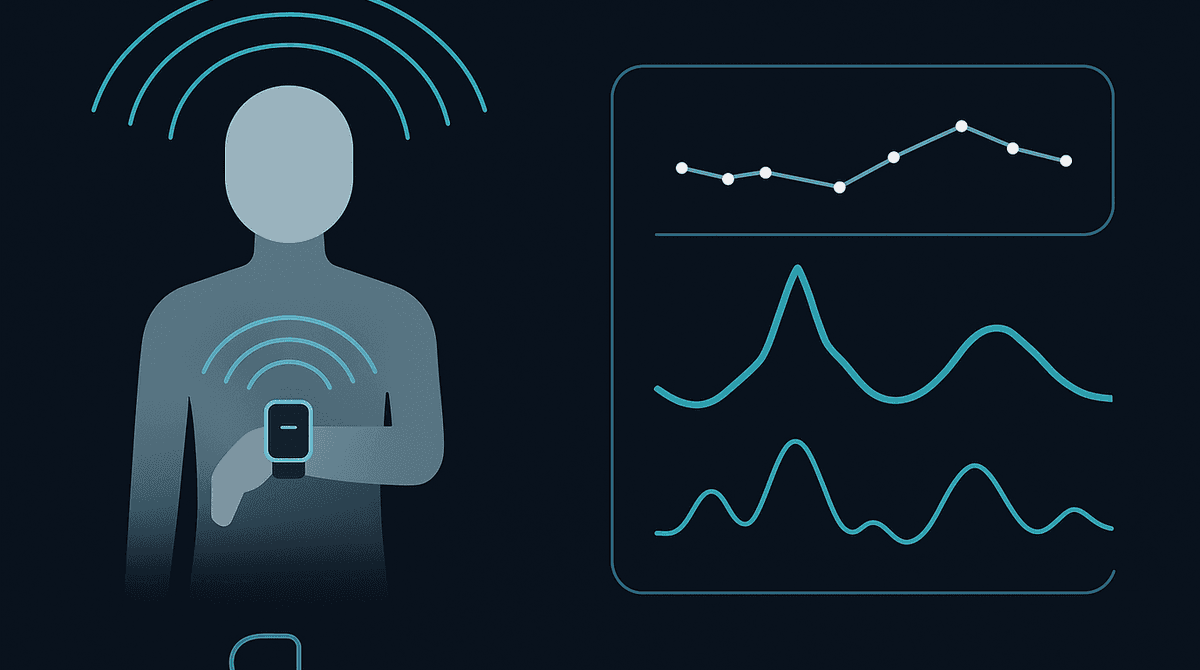
PPG can help detect emotional arousal, but it is much better at tracking intensity than telling whether a person feels good or bad. The most useful biomarkers are heart rate, short term pulse interval variability, pulse amplitude change, and signal quality aware trends, while claims that PPG alone can decode full emotion labels are often overstated.
Emotional arousal and emotional valence are often mixed together in wearable AI marketing. They are not the same target. Arousal asks how activated the body is, from calm to excited or stressed. Valence asks whether the state feels pleasant or unpleasant. PPG, or photoplethysmography, is tied to blood volume changes and cardiac timing, so it sees autonomic activation more directly than it sees subjective meaning.
That distinction matters for emotion tech. A presentation, horror trailer, sprint, or burst of good news can all raise arousal. If a model outputs "joy," "fear," or "anger" from PPG alone, it often learns arousal patterns more than stable emotion categories. Reviews of PPG based emotion recognition reflect this and usually show stronger results for arousal than for rich label sets across people [1][2].
Why PPG is better at arousal than valence
PPG sensors emit light into tissue and measure reflected or transmitted light changes as blood volume shifts with each pulse. From that simple optical signal, models can estimate beat timing, pulse wave amplitude, and parts of pulse shape. Those features are influenced by sympathetic and parasympathetic activity, vascular tone, respiration, temperature, motion, and sensor contact.
Arousal often changes autonomic tone enough to move these signals. Valence does not do that in a consistent way. Similar heart rate acceleration can appear in opposite feelings, and the same person may react differently based on posture, caffeine, exercise, sleep, and context. That is why strong PPG systems are usually framed as activation or stress arousal monitoring, not mind reading.
If you want a broader overview of where PPG fits in affective computing, see PPG emotion recognition and emotion recognition from PPG. For readers focused on stress related activation, PPG stress detection methods covers adjacent use cases.
The PPG biomarkers that actually help
1. Heart rate and inter beat interval change
The most reliable starting point is beat timing. During higher arousal, heart rate often rises and inter beat intervals shorten. That sounds basic, but it remains one of the highest value features in wearable emotion work because it is relatively easy to extract when signal quality is decent.
Useful forms include:
- mean heart rate over a short window
- median inter beat interval
- change from personal baseline
- slope across the last 10 to 60 seconds
- recovery speed after a stimulus or event
Baseline relative change usually beats raw absolute heart rate. A resting rate of 85 bpm can be normal for one user and high for another. Personal calibration is often more helpful than chasing complex model architecture.
2. Short window HRV features
Heart rate variability features derived from pulse intervals can add value, especially when the goal is low versus high arousal over windows long enough to estimate variability with some stability. Time domain features such as SDNN, RMSSD, pNN50, and interval range are commonly used. Frequency domain HRV from PPG is more fragile in short windows and in free living settings, but some studies still report signal when conditions are controlled [1][4].
There is a catch: many HRV features were developed for cleaner ECG or longer recordings. Wrist PPG with motion can distort beat timing enough to make subtle HRV conclusions shaky. In practice, short window HRV helps when you have good pulse detection and a task design that limits movement. It helps less when the person is walking, gesturing, or frequently changing contact pressure.
So HRV is useful, but only with quality gates. A model that treats every pulse interval as equally trustworthy will look smarter in a lab than it does on a real wrist.
3. Pulse amplitude and peripheral vasoconstriction proxies
Arousal is not only about rate. Sympathetic activation can change peripheral blood flow, which can reduce or reshape pulse amplitude. Many papers use features such as pulse amplitude, systolic upstroke characteristics, beat area, and amplitude variability to capture this effect. When a person becomes tense or activated, peripheral vasoconstriction can make the optical pulse smaller or alter the waveform.
This family of features is promising because it reflects vascular response rather than just cardiac timing. It can help distinguish a calm steady heart rate from an activated state where vascular tone also shifts. But amplitude features are easy to contaminate. Loose fit, skin contact changes, ambient light leakage, and motion can all mimic physiological change. They are best treated as secondary evidence, not as a standalone truth signal.
4. Waveform morphology features
Researchers also extract morphology features such as rise time, decay time, pulse width, area ratios, and derivatives. These can reflect vascular response, and some explainable models report useful signal [3][4].
But this is also where hype grows. Morphology is more fragile than simple beat timing. Sampling rate, filtering, hardware, and peak detection choices can all shift the result. If a paper reports excellent emotion classification from many pulse shape features, check whether it survives device changes and everyday noise.
5. Signal quality and context aware features
This category is less glamorous, but often matters most in practice. Good pipelines include signal quality indices, motion flags, missing beat rate, and sometimes temperature or accelerometer context. These are not classic emotional biomarkers, yet they stop the model from making confident claims on bad data.
A wearable that only scores arousal when pulse quality is sufficient is more useful than one that labels emotions continuously no matter what the user is doing.
What claims are mostly hype
"PPG alone can read your emotions"
This is the biggest overstatement. PPG can often detect activation patterns linked to arousal. It does not reliably decode subjective valence or discrete emotions on its own across all users and settings. A label like "anger" may partly reflect motion, context, respiration changes, and study design rather than a generalizable physiological signature.
"More features always means better emotion intelligence"
Large handcrafted feature lists can improve leaderboard numbers in a small dataset, but they also raise overfitting risk. Many PPG emotion datasets are limited, highly scripted, or collected in similar conditions. If performance jumps after adding dozens of pulse shape variables, it is worth checking whether the model is learning the protocol rather than the physiology.
"Lab accuracy transfers directly to the wrist"
A seated participant watching emotional images is not the same as a person living a normal day. Motion artifacts, variable wear position, temperature, speaking, typing, and exercise all reduce signal stability. Arousal models that look excellent in controlled experiments can drop sharply outside the lab. Reviews on wearable emotion recognition make this gap clear [1][2].
"Black box deep learning solved the physiology problem"
Deep models can help with representation learning, but they do not remove the need for valid targets, signal quality control, and careful evaluation. If arousal and valence are mixed in the label design, a neural network will not magically separate them. It will optimize for whatever shortcut the dataset allows.
A practical way to build PPG arousal detection
If the real target is emotional arousal, not full emotion classification, the system design gets cleaner.
Define the target correctly
Use labels that reflect activation level, such as low, medium, or high arousal, or a continuous arousal score. Keep valence separate. If you want both, collect both and model them as different outputs.
Use person relative features
Personal baseline normalization often matters more than model size. Compare current heart rate, interval variability, and pulse amplitude against recent rest or against the user's daily norm. This reduces between person noise.
Prefer robust windows
Very short windows can react quickly but may be noisy. Slightly longer windows, often 30 to 120 seconds depending on the task, tend to support more stable timing and variability estimates. The right choice depends on whether you want event detection or state tracking.
Gate on signal quality
Reject low quality segments. Mark motion contaminated periods. If your data source includes accelerometry, use it. A model that says "insufficient signal" is behaving intelligently.
Add complementary channels when possible
If the product really needs better emotion interpretation, combine PPG with electrodermal activity, respiration, skin temperature, context, or self report. PPG is a good arousal backbone, but multimodal systems usually make stronger claims more honestly. The literature repeatedly shows that wearable emotion recognition improves when PPG is combined with other biosignals rather than forced to carry the full task alone [1][2].
Evaluate across people and sessions
The hardest test is not random train test splitting from one lab session. Better evaluation asks whether the model works on a different day, a different task, or a new user. That is where hype tends to collapse and useful biomarkers stand out.
So which biomarkers deserve your trust?
If you want a realistic priority order for PPG emotional arousal detection, start here:
- Beat timing change, especially heart rate and inter beat interval trends
- Short window HRV features, if beat detection quality is high
- Pulse amplitude and amplitude variability, interpreted carefully
- Selected morphology features that survive device and preprocessing changes
- Signal quality and motion context features that decide when not to score
That list is less flashy than claims about full emotion decoding, but it matches the physiology better. PPG is strongest when it answers, "How activated is the cardiovascular system right now?" It is much weaker when asked, "What exact emotion does this person feel and is it pleasant or unpleasant?"
For product teams, that means the best user promise is often about tracking activation, recovery, or stress arousal trends over time. For researchers, it means separating arousal from valence at the dataset and modeling stage. For clinicians or health adjacent builders, it means treating PPG as one input into emotional state estimation, not a final authority on subjective experience.
FAQ
Can PPG detect emotional arousal?
Yes. PPG can often detect shifts in autonomic activation that correlate with emotional arousal, especially through heart rate, pulse interval variability, and pulse amplitude related features.
Can PPG tell positive excitement from negative stress?
Not reliably on its own. Both states can raise arousal, so PPG is usually better at intensity detection than valence detection. Context or extra sensors are often needed to separate them.
Which PPG features are most useful for arousal detection?
The strongest starting features are heart rate, inter beat interval change, short window HRV measures, and pulse amplitude change. Waveform morphology can help, but it is more sensitive to device and noise issues.
Is HRV from PPG good enough for emotion models?
Sometimes. HRV from clean PPG can help, especially in controlled or low motion conditions, but it is less stable than ECG derived HRV and should be quality checked before use.
Why do many wearable emotion claims sound stronger than the evidence?
Because many studies use small lab datasets, mixed labels, or conditions with limited movement. High accuracy in a controlled protocol does not always transfer to everyday wearable use.
Should I use PPG alone for emotion recognition?
Use it alone only if the goal is narrow and well framed, such as low versus high arousal or recovery tracking. For richer emotion interpretation, combine PPG with context, self report, or other biosignals.
References
Frequently Asked Questions
- Can PPG detect emotional arousal?
- Yes. PPG can often detect shifts in autonomic activation that correlate with emotional arousal, especially through heart rate, pulse interval variability, and pulse amplitude related features.
- Can PPG tell positive excitement from negative stress?
- Not reliably on its own. Both states can raise arousal, so PPG is usually better at intensity detection than valence detection. Context or extra sensors are often needed to separate them.
- Which PPG features are most useful for arousal detection?
- The strongest starting features are heart rate, inter beat interval change, short window HRV measures, and pulse amplitude change. Waveform morphology can help, but it is more sensitive to device and noise issues.
- Is HRV from PPG good enough for emotion models?
- Sometimes. HRV from clean PPG can help, especially in controlled or low motion conditions, but it is less stable than ECG derived HRV and should be quality checked before use.
- Why do many wearable emotion claims sound stronger than the evidence?
- Because many studies use small lab datasets, mixed labels, or conditions with limited movement. High accuracy in a controlled protocol does not always transfer to everyday wearable use.
- Should I use PPG alone for emotion recognition?
- Use it alone only if the goal is narrow and well framed, such as low versus high arousal or recovery tracking. For richer emotion interpretation, combine PPG with context, self report, or other biosignals.