Can PPG Help Detect Driver Distraction? What the Signal Can and Cannot Show
Can PPG help detect driver distraction? Learn where pulse signals reflect workload and arousal, and why they cannot directly verify driver attention shifts.
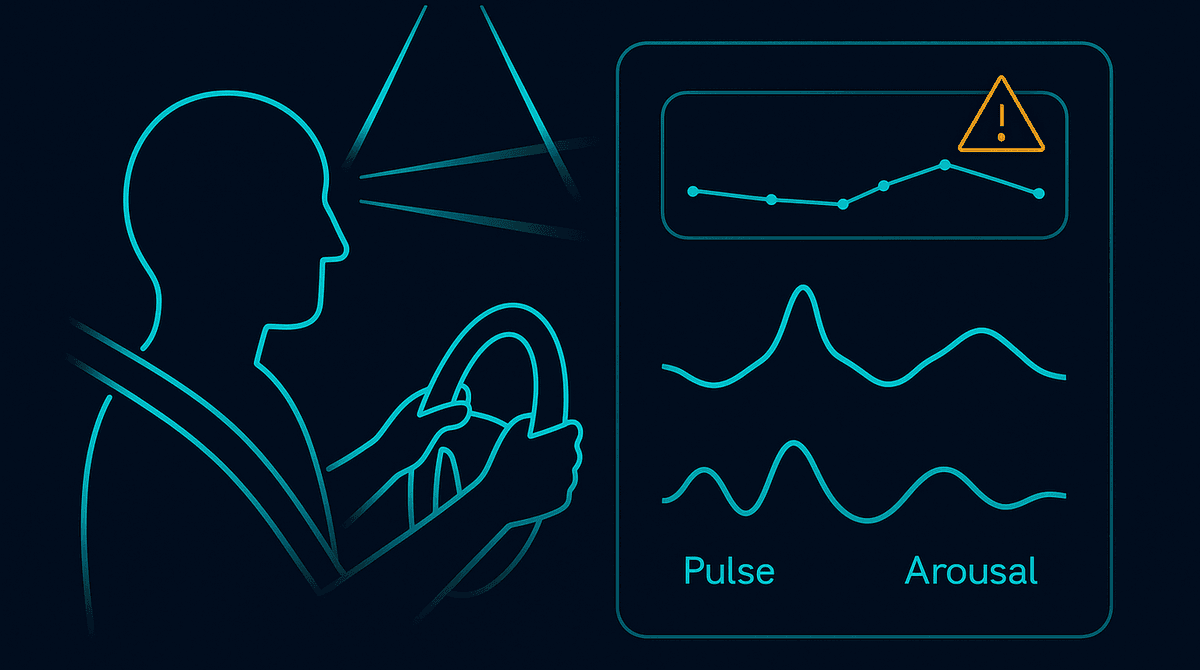
PPG can help detect driver distraction, but only indirectly. It can show changes in heart rate, pulse variability, and vascular response that often track mental workload or arousal, yet it cannot directly tell whether a driver looked away from the road, reached for a phone, or failed to notice a hazard.
Driver distraction is one of the hardest problems in vehicle safety because it is not a single state. A distracted driver may be visually off task, mentally overloaded, manually engaged with another object, or dealing with all three at once. That makes distraction very different from drowsiness, which is often a slower, more continuous shift in alertness. For PPG systems, that difference matters a lot.
Photoplethysmography, or PPG, measures blood volume changes in peripheral tissue using optical sensing. From that waveform, systems can estimate pulse rate, inter beat timing, pulse rate variability, and features related to amplitude and vascular tone. Those signals are useful because the autonomic nervous system often reacts when cognitive demand rises, stress increases, or a driver faces a sudden challenge. Still, the signal reflects physiology, not visual attention itself.
So the right question is not, "Can PPG see distraction?" The better question is, "Can PPG add evidence that a driver is under higher workload or arousal in a way that makes distraction risk more likely?" In many cases, the answer is yes. In isolation, the answer is no.
Why distraction is harder to detect than drowsiness
Drowsiness and distraction are often grouped together in discussions of driver monitoring, but they behave very differently in the body and in the cabin.
Drowsiness usually develops over time. Heart rate patterns, pulse variability, blink behavior, steering corrections, lane keeping, and head posture can all drift in ways that reflect reduced alertness. The signal is still noisy, but the state itself is more stable. That is one reason PPG has a clearer role in fatigue monitoring, which we discuss in /blog/ppg-driver-fatigue-monitoring.
Distraction is less orderly. A driver might glance at a phone for two seconds, argue with a passenger, follow a confusing navigation prompt, or think through a difficult work problem while still looking straight ahead. These forms of distraction do not produce one clean physiological signature. Some raise arousal. Some split attention without much change in heart rate. Some create short bursts that disappear before a wearable sensor can form a strong confidence score.
This is the core reason distraction is harder than drowsiness for PPG. The signal may reflect the strain around distraction, but not the act of distraction itself. A driver can be distracted without strong autonomic change, and a driver can show autonomic change for reasons unrelated to distraction, such as traffic stress, caffeine, heat, conversation, or emotional reaction.
What PPG can actually measure in a driving context
PPG is best understood as a window into cardiovascular response rather than a direct attention monitor. In a vehicle setting, useful PPG derived features may include:
- Pulse rate or heart rate trends
- Pulse rate variability features that track autonomic balance
- Beat to beat interval stability
- Pulse amplitude changes that may reflect vasoconstriction or vasodilation
- Recovery patterns after a cognitively demanding event
When a driver takes on a mentally demanding secondary task, sympathetic activation often increases. That can raise heart rate, reduce some forms of variability, and alter waveform amplitude. If the task is persistent enough and the signal quality is good enough, those changes can help classify elevated workload.
This is where PPG has real value. Many distraction scenarios are not just about where the eyes are. They are also about how much cognitive bandwidth is left for the driving task. A driver who is answering a complex message through voice input may keep eyes forward while mental workload climbs. A camera alone can miss that. PPG can sometimes pick up the physiological cost.
That does not mean PPG is a stand alone distraction detector. It means PPG can contribute a missing dimension: internal state. This is also why there is overlap between distraction work and /blog/ppg-emotion-recognition. Stress, frustration, surprise, and workload can all shape the same physiological channels. The system has to model context carefully or it will confuse one state for another.
Where PPG helps most for distraction detection
PPG is most useful when teams frame distraction as a risk model rather than a binary event detector.
For example, imagine three different situations:
- A driver is reading a message at a stop light.
- A driver is following a confusing route through dense traffic.
- A driver is speaking to a passenger during a routine highway segment.
A camera might do well on the first case because eye and head direction give strong evidence. PPG may add little beyond confirming arousal. In the second case, PPG can be more informative because the main problem is divided attention and rising workload. In the third case, PPG may show mild engagement but should not trigger a strong distraction label if driving performance remains stable.
That pattern points to the best use of PPG: ranking risk, supporting fusion models, and identifying when cognitive load is climbing fast enough that another off task behavior becomes more dangerous.
This is especially relevant for systems built into watches, wristbands, steering wheel sensors, or seat integrated optical sensors. Those form factors can continuously estimate physiological strain without requiring the same camera angle quality that visual systems depend on. In low light, partial face occlusion, sunglasses, or privacy sensitive deployments, PPG can be a valuable companion signal.
What PPG cannot tell you
It is just as important to state the limits plainly.
PPG cannot tell you where a driver is looking. It cannot tell you whether the driver checked a mirror, stared at a center display, or watched a child in the back seat. It cannot identify the source of distraction, such as a phone, touchscreen, passenger, or internal thought. It also cannot reliably separate safe engagement from unsafe distraction without other evidence.
There is also a timing issue. Some distraction events are very short. A two second glance away from the road can be safety critical, but the corresponding cardiovascular response may be small, delayed, or buried in noise. That means a PPG only system may miss the event entirely or recognize it too late to be useful.
PPG is also vulnerable to false positives. An abrupt heart rate change may reflect hard braking, emotional reaction, road stress, temperature, posture change, or poor contact at the sensor site. Without context, the model can over interpret normal variability as distraction risk.
So if your product goal is to detect eyes off road, hands off wheel, or phone interaction, PPG is the wrong primary sensor. If your goal is to estimate whether the driver is entering a high workload or high arousal state that raises error risk, PPG becomes much more relevant.
Signal quality is often the deciding factor
Even a strong physiological concept can fail if the waveform quality is poor. Vehicle vibration, steering corrections, wrist motion, variable contact pressure, ambient light leakage, skin tone adaptation, and cold hands can all distort PPG. In real world driving, those problems are common rather than rare.
This is why signal quality handling is not a side issue. It is the foundation for any believable distraction model. Before classifying workload, a system should know whether beat detection is stable, whether motion artefact is present, and whether a low confidence interval should suppress decisions. We cover these building blocks in more detail in /blog/ppg-signal-quality-assessment.
Good systems usually do four things well:
- They estimate signal quality continuously instead of assuming clean input.
- They fuse physiology over windows that are long enough to be meaningful but short enough to respond.
- They avoid making hard claims when contact is poor or motion is high.
- They train on real driving conditions rather than quiet lab recordings alone.
In practice, this means PPG based distraction support works better for sustained cognitive load than for split second glance events. That distinction should shape product claims, validation plans, and UI design.
The best architecture is multimodal
The strongest driver monitoring systems combine signals that answer different questions.
- Cameras answer: where is the driver looking and how long did the glance last?
- Vehicle dynamics answer: is lane control, braking, or steering quality degrading?
- Device context answers: is a phone or infotainment system in active use?
- PPG answers: is the driver showing elevated workload, stress, or autonomic activation?
This division of labor is where PPG becomes powerful. It does not need to replace camera based distraction detection. It needs to improve confidence around ambiguous states.
Suppose a driver keeps eyes forward but is handling a demanding spoken interaction while traffic complexity increases. A camera may say everything looks normal. Steering metrics may only change slightly. A rising workload signature from PPG can help a fusion model recognize that the driver has less spare attention than appearance alone suggests.
The reverse is also useful. If a camera flags a brief glance away but physiology stays calm and control remains stable, the system may downgrade the severity of the event rather than overreact. That kind of calibration matters in production systems because constant false alarms train users to ignore warnings.
Practical guidance for teams building with PPG
If you are considering PPG for driver distraction applications, the safest product framing is this: use PPG to estimate internal load, not to claim direct knowledge of attention.
A strong implementation plan usually includes the following choices:
- Define distraction subtypes clearly. Separate visual, manual, and cognitive distraction in both labeling and evaluation.
- Treat PPG as an indirect feature source. Use it for workload, arousal, stress, and recovery trends.
- Validate on realistic driving tasks. Include conversation, navigation, secondary screen use, dense traffic, vibration, and temperature variation.
- Measure calibration, not just accuracy. A risk score that knows when it is uncertain is more useful than an overconfident classifier.
- Build conservative user messaging. Say the system detects elevated workload or reduced attentional margin, not that it knows exactly what the driver is doing.
This approach matches what current research suggests. Wearable and contact based physiological sensing can strengthen driver state assessment, especially when combined with behavior and context. But the evidence also points to a limit that product teams should respect: PPG is an indirect marker of how taxed the driver may be, not a direct sensor of where attention is pointed.
That is the honest, technically defensible role for PPG in distraction detection today.
FAQ
Can PPG detect when a driver looks at a phone?
No. PPG cannot directly observe gaze direction or phone use. It may reflect the stress or workload around that behavior, but another sensor is needed to confirm the event.
Is PPG better for drowsiness or distraction?
In general, PPG is better suited to drowsiness and sustained workload than to brief distraction events. Drowsiness is often a more stable physiological state, which makes it easier to model.
What kind of distraction is PPG most useful for?
PPG is most useful for cognitive distraction, especially when mental workload rises even though the driver still appears visually engaged with the road.
Can a smartwatch PPG signal be used for driver monitoring?
Yes, but signal quality, motion handling, and validation are major challenges. Wrist based PPG can support workload estimation, though it should not be treated as a complete distraction detector by itself.
Why does distraction need more than one sensor?
Because distraction includes visual, manual, and cognitive components. No single sensor captures all three well, so multimodal systems usually perform better and make fewer false claims.
Can PPG separate stress from distraction?
Not reliably on its own. Stress, surprise, emotional arousal, and cognitive load can all shift pulse features in similar ways, so context is needed to interpret the signal correctly.
References
Frequently Asked Questions
- Can PPG detect when a driver looks at a phone?
- No. PPG cannot directly observe gaze direction or phone use. It may reflect the stress or workload around that behavior, but another sensor is needed to confirm the event.
- Is PPG better for drowsiness or distraction?
- In general, PPG is better suited to drowsiness and sustained workload than to brief distraction events. Drowsiness is often a more stable physiological state, which makes it easier to model.
- What kind of distraction is PPG most useful for?
- PPG is most useful for cognitive distraction, especially when mental workload rises even though the driver still appears visually engaged with the road.
- Can a smartwatch PPG signal be used for driver monitoring?
- Yes, but signal quality, motion handling, and validation are major challenges. Wrist based PPG can support workload estimation, though it should not be treated as a complete distraction detector by itself.
- Why does distraction need more than one sensor?
- Because distraction includes visual, manual, and cognitive components. No single sensor captures all three well, so multimodal systems usually perform better and make fewer false claims.
- Can PPG separate stress from distraction?
- Not reliably on its own. Stress, surprise, emotional arousal, and cognitive load can all shift pulse features in similar ways, so context is needed to interpret the signal correctly.