Smartwatch Heart Rate Accuracy
Smartwatch heart rate monitors work by shining green (and sometimes red or infrared) light into your skin and measuring how much bounces back. This is...
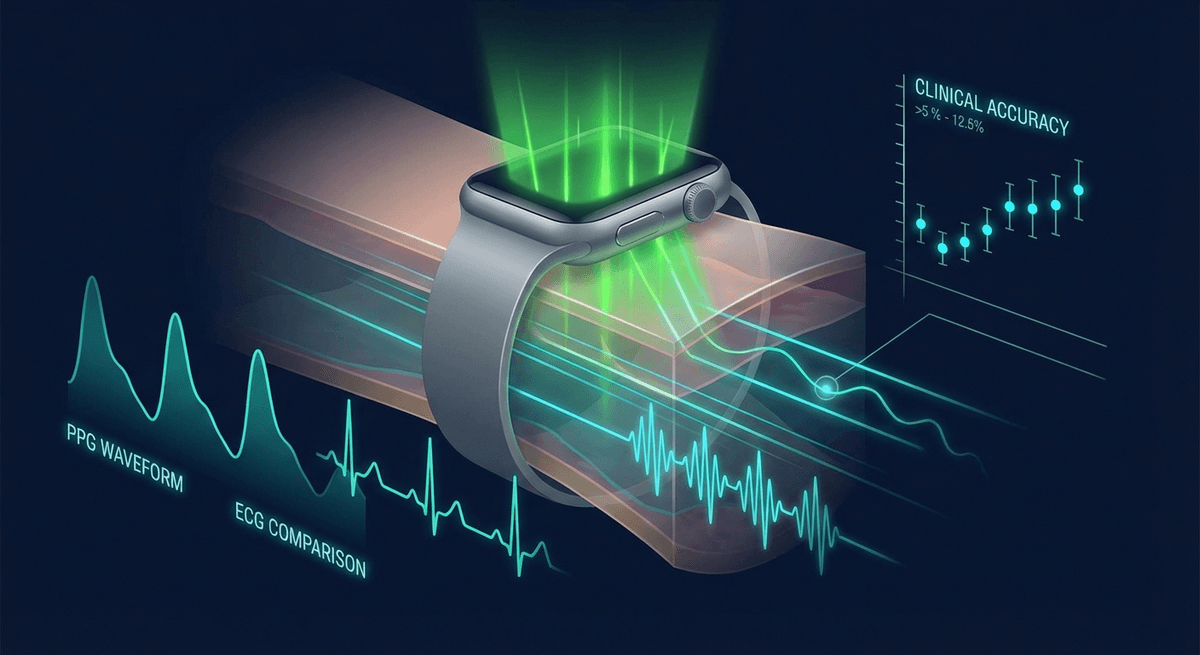
Smartwatch heart rate monitors work by shining green (and sometimes red or infrared) light into your skin and measuring how much bounces back. This is photoplethysmography, or PPG. Under the right conditions, it works well. Under the wrong conditions, it can miss your actual heart rate by 20, 30, or even 50 beats per minute.
Here is what the clinical literature actually shows, and what that means for you.
How Does Optical Heart Rate Sensing Work?
All wrist-worn heart rate monitors use the same basic principle: light from an LED enters the skin, interacts with blood in the capillaries and small arteries beneath, and returns to a photodetector. Because blood volume in those vessels pulses with every heartbeat, the reflected light signal oscillates at your heart rate.
Green light (around 520–530 nm) absorbs well in oxygenated hemoglobin, which makes the cardiac pulse signal easy to isolate. Most consumer devices use two or more green LEDs with a photodetector between them. Some higher-end devices add red and infrared LEDs to also estimate blood oxygen saturation (SpO2).
The raw PPG signal is then processed by algorithms to extract the dominant oscillation frequency, which corresponds to beats per minute. The quality of this extraction is where devices differ enormously.
What Clinical Studies Find
Resting Accuracy
At rest, most modern smartwatches perform reasonably well. A 2020 validation study by Shcherbina et al. published in JMIR mHealth and uHealth (doi:10.2196/18766) found that several commercially available devices, including the Apple Watch Series 4 and Fitbit Charge 3, achieved mean absolute percentage errors below 5% during seated and standing rest conditions.
A systematic review by Evenson et al. (2015, doi:10.1177/1559827615570274) covering earlier-generation devices found that accuracy was much more variable — some devices underperformed by 10–15% even at rest. The newer generations benefit from better photodetector arrays, improved algorithms, and machine learning post-processing.
For clinical purposes, resting heart rate measured by a modern smartwatch is generally accurate enough for trend monitoring, rate-control assessment in known atrial fibrillation, and general wellness tracking.
Exercise Accuracy: Where Things Break Down
Exercise introduces motion artifacts. When your wrist moves during running, cycling, or strength training, the PPG sensor picks up mechanical vibrations that can completely overwhelm the cardiac signal. This is the fundamental challenge of wrist-worn optical sensors.
Multiple studies show accuracy drops significantly during vigorous exercise:
- Running: Mean absolute errors of 5–22 BPM have been reported, depending on device and cadence match. When running cadence (steps per minute) is close to twice the heart rate, the sensor can lock onto the motion artifact frequency instead of the cardiac signal.
- Cycling: Better than running because wrist motion is less intense, but still shows 3–8 BPM errors in most studies.
- Strength training: The worst case. Studies by Gillinov et al. (2017, doi:10.1249/MSS.0000000000001201) found errors exceeding 30 BPM during weight lifting for some devices.
The reason for these failures is fundamental: the PPG frequency spectrum during vigorous exercise contains both the cardiac signal and motion artifact peaks, and separating them requires sophisticated signal decomposition methods (JADE, sparse spectral estimation, or supervised ML models). Some devices handle this better than others, and the performance differences are real.
Which Smartwatches Perform Best?
Direct head-to-head validation studies are published periodically. Some consistent findings:
Apple Watch (Series 4 and later): Consistently among the top performers in independent validation studies. A 2022 study in Heart Rhythm (doi:10.1016/j.hrthm.2022.03.1221) found the Series 7 achieved 96.7% sensitivity for irregular rhythm detection and heart rate errors of 3.1 BPM during moderate exercise.
Garmin (optical HR): Performs well during cycling and structured aerobic exercise. Less consistent during free-weight training. Garmin's Elevate 4.0 sensor generation improved substantially over earlier versions.
Polar Verity Sense: This is an armband worn on the upper arm rather than the wrist, which eliminates most wrist-motion artifacts. Independent tests consistently show it achieving accuracy comparable to chest-strap monitors during vigorous exercise (1–3 BPM error), making it the preferred choice for serious athletes wanting optical HR rather than chest ECG.
Fitbit: Generally accurate for resting and light activity monitoring. Less consistently validated during high-intensity exercise compared to Apple Watch and Garmin.
When Should You Not Trust Your Smartwatch Heart Rate?
There are specific situations where optical wrist HR is unreliable regardless of device quality:
Peripheral vasoconstriction: Cold environments cause blood to shunt away from peripheral capillaries. This dramatically reduces PPG signal amplitude and makes heart rate extraction unreliable. If you feel cold fingers, your wrist PPG reading is probably inaccurate.
Irregular rhythms: During atrial fibrillation, PPG can detect irregularity and trigger an alert, but beat-by-beat heart rate from a PPG monitor is unreliable during AF because the algorithm assumes regular cardiac timing. The displayed "average" heart rate may be reasonable, but moment-to-moment values are not.
Dark skin tones: Studies including one by Sjoding et al. published in NEJM in 2020 (doi:10.1056/NEJMc2029240) documented racial bias in pulse oximetry accuracy. For plain heart rate (not SpO2), the evidence is more mixed, but some studies show modestly higher errors in individuals with Fitzpatrick skin types V–VI, primarily because higher melanin concentrations affect light absorption characteristics.
Wrist tattoos: Tattoo ink can absorb green light and significantly impair the signal. Some manufacturers recommend placing the watch above or below a tattoo.
Loose fit: The device needs firm contact with the skin. A loose band during exercise produces unreliable readings regardless of the algorithm quality.
How to Get Better Accuracy From Your Device
A few practical steps improve accuracy without buying new hardware:
- Wear it tighter than comfortable: One finger-width snug during exercise. The device should not slide on your wrist.
- Move it up your wrist: Position 1–2 cm above the wrist bone to avoid the bony prominence and get more vasculature under the sensor.
- Allow a calibration period: Most devices need 30–60 seconds after you start exercising before the algorithm locks onto your heart rate.
- Consider arm placement: For the most demanding workouts, an upper-arm optical HR band (Polar Verity Sense, Wahoo TICKR FIT) consistently outperforms wrist devices.
Clinical Use Cases: Where Optical HR Monitoring Genuinely Helps
Despite its limitations, optical PPG heart rate monitoring on wearables has demonstrated genuine clinical value in specific use cases:
Long-term trend monitoring: Resting heart rate measured nightly or weekly over months correlates with cardiovascular fitness changes, illness onset, and training load. A sustained increase in resting heart rate is a meaningful signal even if any individual measurement has 2–3 BPM error.
AF screening: The Apple Heart Study enrolled 419,297 participants (the largest prospective digital health study to date) and demonstrated that PPG irregular-pulse detection could identify AF with a positive predictive value of 34% confirmed by ECG patch. For a passive screening tool worn during ordinary life, this represents genuine clinical utility.
Rate control monitoring in known AF: For patients on rate-control therapy (beta-blockers, digoxin), daily HR trends from a wearable provide clinically relevant information about medication effect and activity response.
Heart failure management: A 2021 pilot study demonstrated that daily wrist PPG-derived resting heart rate and heart rate variability trends could predict heart failure exacerbations 1–3 days before symptom onset, potentially enabling early intervention.
The Bottom Line
Smartwatch heart rate accuracy is good enough for many health monitoring applications and inadequate for others. At rest, expect 2–4 BPM error from a quality device. During moderate aerobic exercise, expect 3–8 BPM error. During vigorous exercise or strength training, errors can exceed 20 BPM.
For rhythm screening, AF detection, and long-term trend monitoring, current devices provide genuine clinical value. For precise exercise training zones, research-grade heart rate variability analysis, or cardiac rehabilitation intensity monitoring, a chest-strap ECG or dedicated medical device remains the appropriate choice.
Understanding what your device actually measures, and when to trust it, is more valuable than any individual reading.
FAQ
How accurate is the Apple Watch heart rate monitor? Clinical validation studies typically show the Apple Watch achieves mean absolute errors of 2–4 BPM at rest and 3–8 BPM during moderate aerobic exercise. During vigorous strength training, errors can exceed 10 BPM. It is among the most validated consumer devices in the peer-reviewed literature.
Why does my smartwatch give wrong heart rate readings during exercise? Motion artifacts from wrist movement create oscillations in the PPG signal that can match or overwhelm the cardiac signal frequency. This is most pronounced during activities with repetitive wrist movement (running, strength training) and least pronounced during cycling or activities with stable wrist position.
Is an optical heart rate sensor the same as a medical ECG? No. ECG (electrocardiogram) measures the electrical signals generated by the heart and provides diagnostic information about cardiac conduction, ischemia, and arrhythmia type. Optical PPG measures the mechanical consequence of each heartbeat, reflected in blood volume changes at the skin. PPG can estimate heart rate and detect rhythm irregularity but cannot diagnose specific arrhythmia types or detect ischemic changes.
Does skin tone affect smartwatch heart rate accuracy? For heart rate (not SpO2), the evidence is mixed. Some studies show modestly higher errors in individuals with darker skin tones due to melanin affecting green light absorption, while others find no significant difference after algorithm training on diverse datasets. The bias is better documented for SpO2 estimation than for heart rate.
Can a smartwatch detect atrial fibrillation accurately? Modern smartwatches can screen for irregular pulse patterns consistent with AF with reasonable sensitivity (around 93–98% in controlled studies). However, a positive "irregular rhythm" notification requires ECG confirmation before clinical decisions are made. Smartwatches are screening tools, not diagnostic devices.
What is the most accurate wrist heart rate monitor? Independent validation studies consistently rank armband devices like the Polar Verity Sense at the top for exercise accuracy, followed by Apple Watch Series 7+ and Garmin Forerunner/Fenix series. For pure resting-to-light-activity monitoring, differences between major brands are small.
Should I trust my smartwatch heart rate during a workout? For moderate-intensity cardio (running, cycling at conversation pace), modern smartwatches are generally reliable enough for training guidance. For high-intensity intervals, heavy lifting, or clinical purposes, supplement with a chest-strap monitor or ECG-based device.
Frequently Asked Questions
- How accurate is the Apple Watch heart rate monitor?
- Clinical validation studies typically show the Apple Watch achieves mean absolute errors of 2–4 BPM at rest and 3–8 BPM during moderate aerobic exercise. During vigorous strength training, errors can exceed 10 BPM.
- Why does my smartwatch give wrong heart rate readings during exercise?
- Motion artifacts from wrist movement create oscillations in the PPG signal that can match or overwhelm the cardiac signal frequency. This is most pronounced during activities with repetitive wrist movement (running, strength training).
- Can a smartwatch detect atrial fibrillation accurately?
- Modern smartwatches can screen for irregular pulse patterns consistent with AF with reasonable sensitivity (around 93–98% in controlled studies). A positive notification requires ECG confirmation before clinical decisions are made.
- Is an optical heart rate sensor the same as a medical ECG?
- No. ECG measures the electrical signals generated by the heart and provides diagnostic information about cardiac conduction, ischemia, and arrhythmia type. Optical PPG measures the mechanical consequence of each heartbeat and can estimate heart rate and detect rhythm irregularity but cannot diagnose specific arrhythmia types.