How Accurate Is Garmin VO2 Max? Data, Studies & Limitations
An in-depth analysis of Garmin VO2 max accuracy examining the Firstbeat algorithm, validation studies including Passler et al. (2019), typical error margins of plus or minus 5%, factors affecting estimates, and how to interpret your Garmin fitness age and VO2 max readings against laboratory-measured values.
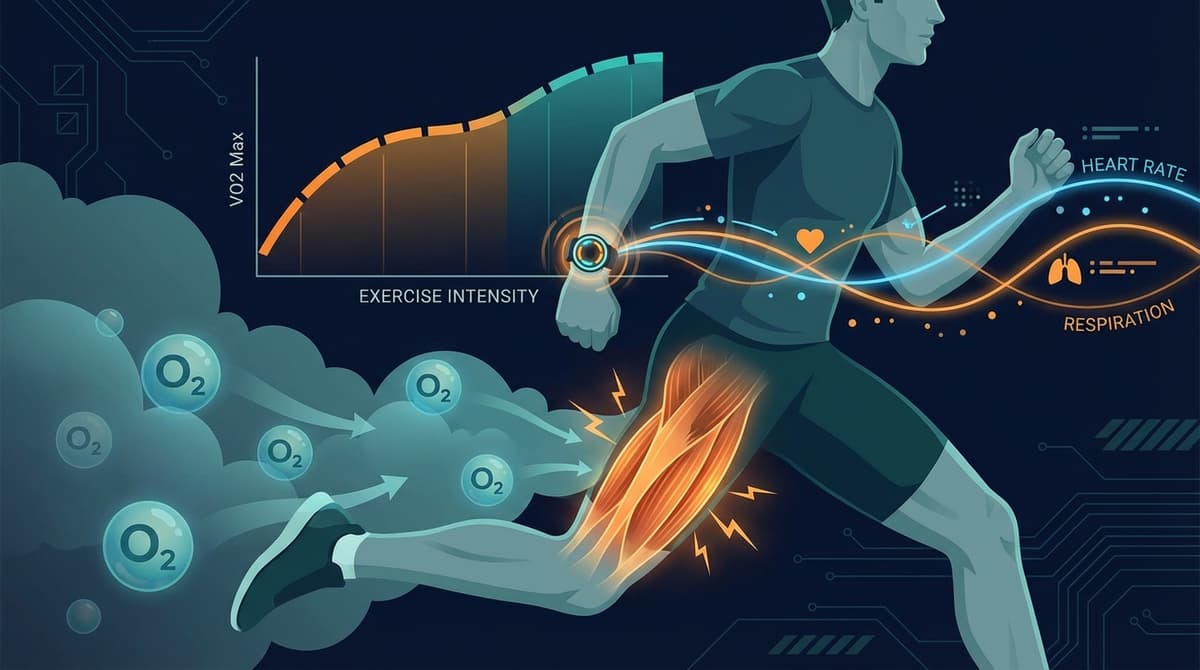
Garmin VO2 max estimates are typically accurate within plus or minus 5% of laboratory-measured values for trained runners, based on validation studies including Passler et al. (2019), but accuracy degrades significantly for untrained individuals and in non-ideal conditions. The Firstbeat algorithm powering Garmin's estimate uses the relationship between heart rate and running pace to extrapolate maximal oxygen uptake, a method that works well under controlled conditions but is sensitive to heat, altitude, fatigue, cardiac drift, and individual physiological variation.
VO2 max is widely regarded as the single best indicator of cardiorespiratory fitness and is strongly associated with all-cause mortality risk. The appeal of having a lab-quality metric estimated from a wrist-worn device during everyday runs is obvious. But the gap between marketing promise and measurement reality is important to understand. This article examines the algorithm, the validation evidence, the conditions that cause errors, and how to interpret your Garmin VO2 max number accurately.
For background on how Garmin's optical heart rate sensor captures the data underlying these estimates, see our guide to PPG technology.
How the Firstbeat Algorithm Estimates VO2 Max
Garmin licenses its VO2 max estimation algorithm from Firstbeat Analytics (now part of Garmin). The algorithm uses the well-established physiological relationship between oxygen consumption and heart rate during submaximal exercise to estimate what an individual's maximal oxygen uptake would be if pushed to exhaustion.
The core principle is straightforward. During aerobic exercise, there is a roughly linear relationship between exercise intensity (oxygen consumption) and heart rate. If the algorithm knows your heart rate at a given running pace, it can estimate the oxygen cost of that pace and then extrapolate to predict what your heart rate and oxygen consumption would be at maximal effort.
Specifically, the algorithm uses the following inputs:
- Heart rate data from the wrist-based PPG sensor or a paired chest strap, sampled continuously during the run
- Running pace derived from GPS positioning, used as a proxy for running economy and oxygen cost
- User profile data including age, sex, weight, and height, which influence the physiological models
- Environmental context such as altitude (from barometric altimeter) and, in newer models, heat and altitude acclimation adjustments
The algorithm requires a sustained effort of at least 10-15 minutes with heart rate elevated above approximately 70% of estimated maximum heart rate. It fits the observed heart rate and pace data to a physiological model, adjusting for known factors like cardiac drift (gradual heart rate rise during prolonged exercise at constant pace) and running economy variations.
The VO2 max estimate is not based on a single run. Garmin uses a rolling weighted average that emphasizes recent high-quality recordings while filtering out outlier sessions. This smoothing approach reduces day-to-day noise but means your displayed VO2 max value lags behind your actual fitness by days to weeks. Understanding these signal processing algorithms in context helps explain why the number changes gradually rather than jumping after a single great workout.
Validation Studies: What the Research Shows
Passler et al. (2019)
Passler et al. (2019) conducted one of the most cited validation studies comparing Garmin watch VO2 max estimates against gold-standard metabolic cart testing (indirect calorimetry during a graded exercise test on a treadmill). The study recruited recreational to trained runners and compared their Garmin-estimated VO2 max values against laboratory-measured values.
Key findings included:
- Mean absolute error of approximately 3.5 ml/kg/min, corresponding to about 5-7% of the measured VO2 max value for most participants
- Correlation coefficient of approximately r = 0.87-0.93 between Garmin estimates and lab values, indicating strong but not perfect agreement
- Systematic bias tended toward slight overestimation in less-trained individuals and slight underestimation in highly trained individuals
- Individual variation was substantial: while the average error was moderate, some individuals had estimates more than 8-10 ml/kg/min away from their lab value
Other Validation Research
Multiple other studies have evaluated Firstbeat-based VO2 max estimation with broadly consistent results:
| Study | Population | Mean Error | Correlation |
|---|---|---|---|
| Passler et al. (2019) | Recreational runners | ~3.5 ml/kg/min | r = 0.87-0.93 |
| Kraft et al. (2020) | Trained cyclists (running test) | ~4.2 ml/kg/min | r = 0.82 |
| Snyder et al. (2019) | College-age adults | ~3.8 ml/kg/min | r = 0.88 |
| Garmin/Firstbeat internal | Mixed fitness levels | ~3.0 ml/kg/min | r = 0.94 |
The pattern across studies is consistent: for trained runners performing outdoor GPS runs, the algorithm works reasonably well. For populations or conditions outside this sweet spot, accuracy degrades. For more context on how heart rate measurement accuracy affects these estimates, see our Apple Watch vs chest strap comparison.
Factors That Degrade Accuracy
Understanding the conditions that cause errors is essential for interpreting your Garmin VO2 max number. The algorithm assumes specific physiological conditions, and violations of these assumptions introduce error.
Heat and Humidity
Heat is the single most impactful environmental factor on VO2 max estimate accuracy. In hot conditions, the cardiovascular system diverts blood to the skin for cooling, which increases heart rate at any given running pace. The algorithm interprets this elevated heart rate as reduced fitness, producing a lower VO2 max estimate that does not reflect actual cardiorespiratory capacity.
The effect is substantial. Running in 35-degree Celsius heat versus 15-degree Celsius can elevate heart rate by 10-20 BPM at the same pace, which can depress the VO2 max estimate by 3-8 ml/kg/min. Newer Garmin watches include heat acclimation adjustments that partially compensate for this, but the correction is imperfect because individual heat tolerance varies widely.
Altitude
Altitude reduces the partial pressure of oxygen in inspired air, which increases heart rate at a given effort level. Running at 2,000 meters elevation versus sea level typically elevates heart rate by 5-15 BPM for the same pace. The Garmin algorithm in newer watches includes altitude acclimation tracking, but like the heat correction, it is an approximation that may not fully account for individual responses.
Cardiac Drift and Run Duration
During prolonged runs (beyond 45-60 minutes), heart rate gradually rises even at constant pace due to factors including dehydration, core temperature increase, and declining stroke volume. This cardiac drift can inflate heart rate by 10-15 BPM over the course of a long run. The algorithm attempts to account for drift, but extreme cases (very long runs in heat) can still produce lower estimates.
Heart Rate Accuracy at the Wrist
The Garmin VO2 max estimate is only as good as the heart rate data feeding it. Wrist-based PPG heart rate measurement has known limitations, particularly during exercise with significant arm movement. If the watch reports heart rate that is systematically too high or too low during running, the VO2 max estimate will be correspondingly affected. For optimal accuracy, pairing a chest strap heart rate monitor eliminates this source of error. See our detailed guide on wearable heart rate monitors for device recommendations.
Running Surface and Terrain
The algorithm uses GPS-derived pace as a proxy for running effort. On hilly terrain, the oxygen cost of running varies significantly with gradient, and while Garmin watches with barometric altimeters can adjust for elevation changes, the correction is imperfect. Running on trails with frequent elevation changes, technical terrain requiring slower pace, or soft surfaces like sand or mud will introduce pace-based errors.
Running on a treadmill without a footpod presents additional challenges because there is no GPS pace data. Garmin uses the accelerometer to estimate pace indoors, which is less accurate than GPS-based pace outdoors.
Fitness Level and Training Background
The Firstbeat algorithm is best calibrated for individuals with moderate to high cardiorespiratory fitness who run regularly. For untrained individuals, the relationship between heart rate and running pace is less predictable due to higher variability in running economy, less efficient biomechanics, and more erratic pacing patterns. Studies consistently show larger estimation errors in untrained versus trained populations.
Similarly, athletes who primarily train in non-running activities (cycling, swimming, rowing) may have a high actual VO2 max that the Garmin running-based estimate undervalues because their running economy is not well-developed. A cyclist with a lab VO2 max of 60 ml/kg/min may get a Garmin running estimate of only 50-52 ml/kg/min because they run at relatively high heart rates for their pace compared to trained runners.
Lab Testing vs Garmin: What You Are Actually Comparing
Understanding what a laboratory VO2 max test measures versus what Garmin estimates is crucial for interpreting the comparison.
A laboratory graded exercise test (GXT) measures actual oxygen consumption by analyzing expired gases (O2 and CO2 concentrations and ventilation volume) while the subject exercises to volitional exhaustion on a treadmill or cycle ergometer. The test produces a true VO2 max value when specific physiological criteria are met: a plateau in oxygen consumption despite increasing workload, respiratory exchange ratio above 1.10, and heart rate near age-predicted maximum.
The Garmin estimate, by contrast, is a submaximal prediction. It never requires the user to exercise at maximum effort. It observes the heart rate response at moderate to hard (but not maximal) effort levels and extrapolates. This means the Garmin value is fundamentally an estimate with inherent uncertainty, no matter how good the algorithm becomes.
Moreover, laboratory VO2 max itself has a test-retest variability of approximately 2-4%. Even if you perform two lab tests on consecutive days under identical conditions, the results may differ by 1-2 ml/kg/min. This means that some of the apparent "error" in Garmin estimates relative to lab values is actually measurement noise in the lab reference itself.
For practical purposes, the most important question is not whether the absolute number matches a lab test but whether the Garmin estimate accurately tracks changes in fitness over time. Longitudinal accuracy (detecting a 3 ml/kg/min improvement after a training block) is arguably more useful than absolute accuracy (matching a lab value exactly). Evidence suggests that Garmin estimates do track fitness changes reasonably well, with improvements in lab VO2 max reflected in the watch estimate, though with variable lag time and smoothing. To understand how PPG peak detection quality influences these longitudinal trends, see our algorithm guide.
Understanding Garmin Fitness Age
Garmin Fitness Age maps your estimated VO2 max to age-based percentile norms from the American College of Sports Medicine (ACSM) and similar population databases. If your VO2 max corresponds to the average for a 25-year-old, your Fitness Age is displayed as 25, regardless of your actual chronological age.
This metric is motivational rather than clinical. Its accuracy depends entirely on the underlying VO2 max estimate. A plus or minus 5% error in VO2 max can shift the Fitness Age by 3-7 years, particularly in the middle ranges where the percentile curves are steeper. At the extremes (very high or very low fitness), a given error in VO2 max may correspond to a smaller or larger Fitness Age shift depending on the slope of the age-percentile curve.
Fitness Age also does not account for factors beyond VO2 max that contribute to biological aging and health, including body composition, strength, flexibility, metabolic health, and cognitive function. A person with a high VO2 max but significant metabolic dysfunction would have a flattering Fitness Age that does not reflect their overall health status.
How to Maximize Garmin VO2 Max Accuracy
Based on the algorithm's design and known error sources, these practices will produce the most reliable VO2 max estimates:
Use a chest strap for heart rate. Pairing a Polar H10 or similar chest strap eliminates wrist-based PPG heart rate errors, which are one of the largest controllable sources of estimation error.
Run outdoors with GPS on flat routes. GPS pace on flat terrain provides the most accurate effort estimation input. Avoid hilly routes, tracks with tight turns (GPS error), and treadmill sessions for VO2 max qualifying runs.
Run in moderate temperatures. Temperatures between 10-20 degrees Celsius minimize heat-related heart rate elevation. If you train primarily in hot climates, expect consistently lower estimates during summer.
Include sustained tempo efforts. The algorithm extracts the most information from sustained moderate-to-hard efforts (around tempo pace, roughly 80-90% max HR) lasting 20-30 minutes. Easy jogs provide less discriminating data for the model.
Keep your profile accurate. Ensure your age, weight, height, and max heart rate are correct in the Garmin Connect settings. Errors in these values propagate directly into the VO2 max model.
Be patient with the rolling average. Do not overreact to a single session's impact on your displayed VO2 max. The rolling average algorithm is designed to smooth noise, so trust the long-term trend rather than week-to-week fluctuations. For more on how wearable data should be interpreted over time, see our guide on how to improve HRV, which discusses similar trend-based interpretation.
Cycling VO2 Max: A Different (and Less Accurate) Estimate
Garmin also provides VO2 max estimates for cycling, which use power meter data instead of GPS pace as the effort metric. In principle, power output is a more direct measure of work rate than running pace, which should improve accuracy. However, cycling VO2 max estimates introduce their own challenges.
Cycling VO2 max is typically 5-15% lower than running VO2 max for the same individual because cycling uses less muscle mass and produces lower peak oxygen consumption. The Garmin algorithm accounts for this, but the adjustment is population-averaged and may not reflect your specific running-to-cycling VO2 max ratio.
Additionally, cycling heart rate is influenced by factors like position on the bike, drafting, and coasting on descents, which do not have running equivalents. Power meter accuracy and calibration add another layer of potential error. For serious cyclists who want accurate VO2 max tracking, laboratory testing with a cycle ergometer protocol remains the most reliable option.
The Bottom Line: Useful but Imperfect
The Garmin VO2 max estimate is a valuable fitness metric that provides directionally accurate information about cardiorespiratory fitness for most regular runners. Its greatest strength is longitudinal tracking: watching your VO2 max trend over months and years of training provides meaningful insight into whether your fitness is improving, maintaining, or declining.
Its greatest weakness is the temptation to treat the absolute number as precise. A displayed VO2 max of 48 ml/kg/min should be interpreted as "approximately 45-51 ml/kg/min" given the typical error margins. Comparing your Garmin number directly against a friend's Garmin number or against published VO2 max values for athletes is misleading because the error margins overlap substantially.
For users who want a definitive VO2 max measurement, there is no substitute for a laboratory graded exercise test with metabolic cart analysis. For everyone else, the Garmin estimate is a useful, free, and non-invasive proxy that improves the more consistently you use it under favorable conditions. For a broader comparison of how different wearables measure fitness metrics, see our best heart rate monitor 2026 guide.
Frequently Asked Questions
How accurate is the VO2 max estimate on Garmin watches?
Garmin VO2 max estimates are typically within plus or minus 5% of laboratory-measured values for trained runners who use the watch consistently during outdoor GPS runs. Passler et al. (2019) found a mean error of approximately 3.5 ml/kg/min compared to metabolic cart testing. However, accuracy varies significantly based on fitness level, running experience, and usage patterns. Trained endurance athletes who run regularly outdoors tend to get the most accurate estimates, while untrained individuals, treadmill-only runners, and those who primarily do non-running activities may see errors of 10-15% or more.
Why does my Garmin VO2 max seem too low or too high?
Several factors can cause inaccurate Garmin VO2 max estimates. If your estimate seems too low, common causes include running in heat or humidity (which elevates heart rate independent of effort), high altitude, running on hilly terrain without altimeter correction, cardiac drift during long runs, caffeine or dehydration effects, and illness or poor recovery. If your estimate seems too high, this may be due to running at paces well below threshold (the algorithm extrapolates), drafting effects in group runs, GPS pace errors on tracks or tight courses, or having an unusually low heart rate at given paces due to genetics or medications like beta blockers.
Is the Garmin Fitness Age feature accurate?
Garmin Fitness Age is a motivational metric derived from your VO2 max estimate mapped against age-based population norms from the American College of Sports Medicine. Its accuracy depends entirely on how accurate your VO2 max estimate is, which means it inherits all the same limitations and error margins. If your VO2 max is accurate to within plus or minus 5%, your Fitness Age could shift by approximately 3-7 years in either direction from its true value. It is most useful as a long-term trend indicator rather than a precise measurement, and it should not be compared directly between individuals with different body compositions or activity profiles.
How can I get the most accurate VO2 max reading from my Garmin?
To maximize Garmin VO2 max accuracy, run outdoors with GPS on flat terrain in moderate weather conditions (15-20 degrees Celsius). Run at a steady moderate effort (tempo pace or sustained threshold effort) for at least 20-30 minutes, which gives the algorithm the best heart rate and pace data to work with. Ensure your watch fits snugly about one finger-width above the wrist bone for optimal heart rate accuracy. Keep your user profile accurate (age, weight, height). Avoid recording VO2 max-qualifying runs when fatigued, dehydrated, in extreme heat or cold, or at altitude. Use a chest strap heart rate monitor paired to the watch for the most reliable heart rate data input.
Frequently Asked Questions
- How accurate is the VO2 max estimate on Garmin watches?
- Garmin VO2 max estimates are typically within plus or minus 5% of laboratory-measured values for trained runners who use the watch consistently during outdoor GPS runs. Passler et al. (2019) found a mean error of approximately 3.5 ml/kg/min compared to metabolic cart testing. However, accuracy varies significantly based on fitness level, running experience, and usage patterns. Trained endurance athletes who run regularly outdoors tend to get the most accurate estimates, while untrained individuals, treadmill-only runners, and those who primarily do non-running activities may see errors of 10-15% or more.
- Why does my Garmin VO2 max seem too low or too high?
- Several factors can cause inaccurate Garmin VO2 max estimates. If your estimate seems too low, common causes include running in heat or humidity (which elevates heart rate independent of effort), high altitude, running on hilly terrain without altimeter correction, cardiac drift during long runs, caffeine or dehydration effects, and illness or poor recovery. If your estimate seems too high, this may be due to running at paces well below threshold (the algorithm extrapolates), drafting effects in group runs, GPS pace errors on tracks or tight courses, or having an unusually low heart rate at given paces due to genetics or medications like beta blockers.
- Is the Garmin Fitness Age feature accurate?
- Garmin Fitness Age is a motivational metric derived from your VO2 max estimate mapped against age-based population norms from the American College of Sports Medicine. Its accuracy depends entirely on how accurate your VO2 max estimate is, which means it inherits all the same limitations and error margins. If your VO2 max is accurate to within plus or minus 5%, your Fitness Age could shift by approximately 3-7 years in either direction from its true value. It is most useful as a long-term trend indicator rather than a precise measurement, and it should not be compared directly between individuals with different body compositions or activity profiles.
- How can I get the most accurate VO2 max reading from my Garmin?
- To maximize Garmin VO2 max accuracy, run outdoors with GPS on flat terrain in moderate weather conditions (15-20 degrees Celsius). Run at a steady moderate effort (tempo pace or sustained threshold effort) for at least 20-30 minutes, which gives the algorithm the best heart rate and pace data to work with. Ensure your watch fits snugly about one finger-width above the wrist bone for optimal heart rate accuracy. Keep your user profile accurate (age, weight, height). Avoid recording VO2 max-qualifying runs when fatigued, dehydrated, in extreme heat or cold, or at altitude. Use a chest strap heart rate monitor paired to the watch for the most reliable heart rate data input.