Can a Phone Camera Measure Respiratory Rate?
A phone camera can estimate respiratory rate in calm, well-lit conditions, but it is best used as a guided spot check, not a replacement for clinical respiratory monitoring.
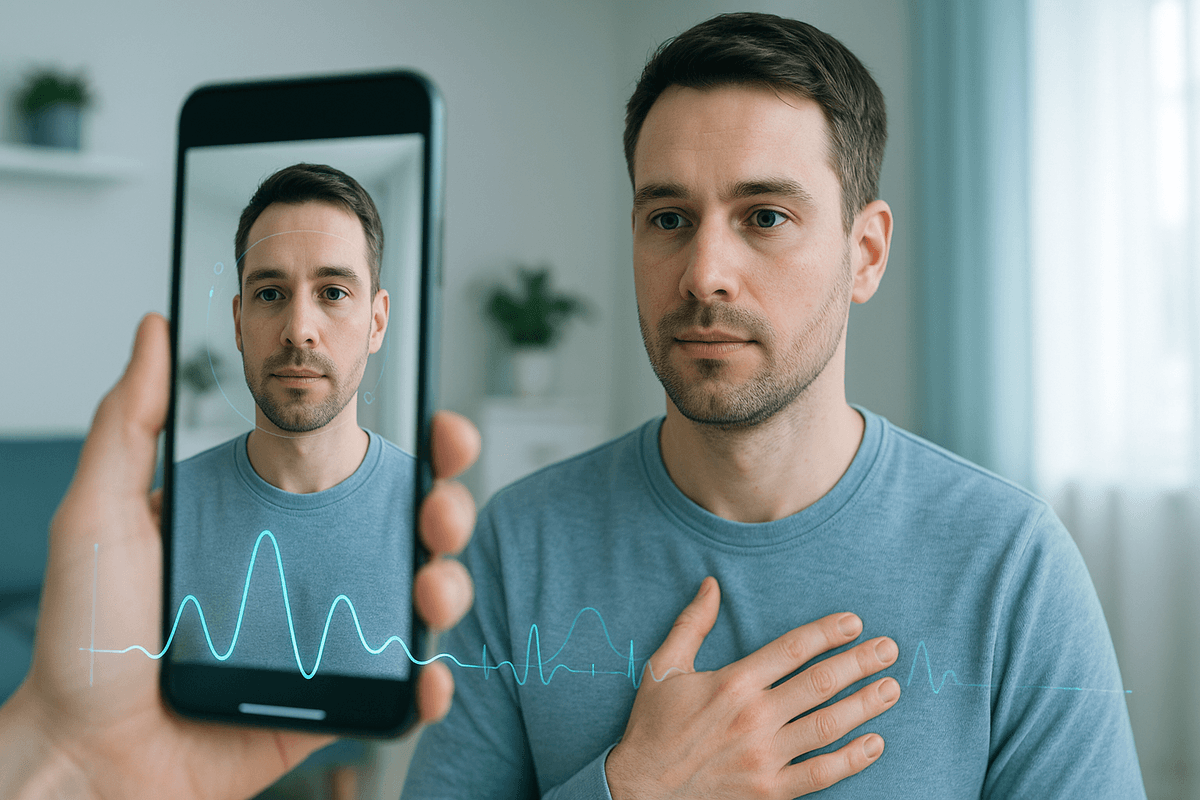
Yes, a phone camera can estimate respiratory rate, but only in a narrow set of conditions: the person has to be still, the lighting has to cooperate, and the recording window has to be long enough to capture a usable breathing pattern. That makes it useful for guided telehealth spot checks and consumer wellness flows, but not a substitute for clinical respiratory monitoring when someone is unstable, distressed, or moving around.
What a phone camera is actually measuring
A phone camera does not measure breathing the way a capnography sensor or respiratory belt does. It is inferring breathing from secondary signals.
There are two common approaches.
1. Motion-based estimation. The camera watches the upper chest, shoulders, neck, or lower face and tracks subtle motion linked to inhalation and exhalation. This is conceptually simple, but it breaks fast when the user talks, shifts posture, changes camera angle, or wears loose clothing.
2. PPG or rPPG-based estimation. Here the system extracts a pulsatile optical signal and then looks for respiratory modulation inside it. Breathing changes venous return, stroke volume, and autonomic tone. Those effects create low-frequency changes in pulse amplitude, frequency, and baseline. The article on PPG respiratory rate estimation goes deeper into those mechanisms, and our contactless vital signs overview covers the camera side.
For telehealth products, that second path is usually more interesting because it can run during a guided front-camera or fingertip measurement without asking the patient to count breaths manually.
The short answer on accuracy
If you want the blunt version, here it is: camera-derived respiratory rate can work for calm adults at rest, and it gets shaky once real life shows up.
Repo-internal sources already point to that pattern. Our smartphone vitals review cites Nam et al. with a respiratory rate mean absolute error around 1.2 breaths per minute in a small resting dataset using smartphone PPG. Our camera vital signs coverage also points to later facial-video work showing respiratory rate can be extracted from face video under controlled conditions. Those are encouraging results, but they are not the same thing as saying, "your average telehealth call can replace a respiratory exam with a selfie clip."
That distinction matters because respiratory rate is one of the easiest vitals to distort operationally. People hold their breath when they are being observed. They talk. They reposition the phone. They laugh. They breathe through symptoms. The measurement problem is not just algorithmic. It is behavioral.
Why respiratory rate is harder than it looks
Clinicians already know respiratory rate is often the least reliably captured vital sign in routine practice. The reason is simple: the signal is slow, context-sensitive, and strongly affected by patient behavior.
Camera systems inherit all of that, plus camera-specific noise:
- head and torso motion n- rolling shutter and low frame consistency
- auto-exposure changes during the clip
- compression artifacts
- poor framing of the face or torso
- talking, coughing, or swallowing during the capture
With heart rate, you can often recover a dominant pulse frequency even from imperfect video. With breathing, the target signal sits closer to the motion and lighting junk that the camera is already struggling with. That is why the quality controls described in remote photoplethysmography accuracy factors are not optional. A respiratory number without a quality gate is asking for trouble.
The other issue is capture duration. A ten-second clip may feel snappy in product design, but it does not always contain enough stable cycles to separate real respiration from transient movement. Slower breathers make that worse. If your user takes eight breaths per minute and you only capture for a short window, you barely have enough cycles to estimate anything with confidence. Teams that optimize only for conversion often end up starving the model of the one thing it actually needs: time.
Fingertip camera vs face camera
This is where product teams often confuse two very different categories.
Fingertip camera measurements use contact PPG, even though the sensor is still the phone camera. The user places a finger over the lens, often with flash illumination. That tends to produce a stronger optical waveform. From there, the app can estimate respiratory rate indirectly by analyzing respiratory-induced modulation in the pulse waveform.
Face camera measurements are true contactless rPPG or motion-based approaches. They are easier to insert into a telehealth visit because the patient does not need to touch the camera or use the flash. But they are more fragile, especially on low-end webcams, under mixed lighting, or during active conversation.
If you are building a consumer check-in flow before a visit, fingertip capture may give you a more robust spot check. If you are trying to add passive measurement during a live virtual visit, face video is more convenient but less forgiving. That tradeoff is exactly why rPPG telehealth remote monitoring and rPPG video conferencing vital signs should be read together rather than treated as the same thing.
Where phone camera respiratory rate is useful
There are solid use cases.
Low acuity telehealth intake. If a patient is checking in for a routine follow-up, mental health visit, urgent care screening, or post-discharge questionnaire, a guided camera-based spot check can reduce friction compared with asking them to own and use a respiratory device.
Trend monitoring. Camera respiratory rate is more defensible when it is repeated the same way over time and used to look for change, not to make a one-shot high stakes decision.
Workflow support for staff. If the alternative is no respiratory data at all, a decent guided estimate can be operationally valuable. Many telehealth organizations still document "respiratory rate unavailable" for a large share of visits.
Patient engagement. A quick breathing-rate capture can help orient a patient to the fact that physiologic measurement is part of the visit, not just a questionnaire.
That said, there are settings where I would not lean on it.
Where it should not carry the clinical load
Do not pretend a phone camera solves respiratory monitoring for:
- shortness of breath triage
- COPD or asthma flare assessment
- pneumonia or sepsis concern
- pediatric distress
- post-op respiratory surveillance
- sleep-disordered breathing screening
- any situation where escalation depends on a precise respiratory number
In those cases, a camera estimate can be a supplemental signal at best. If the result matters, confirm it with direct observation, a respiratory belt, capnography, or another clinically validated workflow.
This is the same commercial mistake teams make with camera blood pressure. The measurement may look possible in a demo, but the care pathway collapses if the error bands are wider than the decision threshold.
What good product design looks like
If you ship phone-camera respiratory rate, the product should behave like it respects the physics.
Give the user clear constraints. Sit still. Stop talking. Rest the phone. Record for long enough. Keep the face or fingertip properly framed.
Use quality checks aggressively. If the signal is poor, say so and ask for a retake. Silent failure is worse than no reading.
Show confidence, not false certainty. A narrow-looking integer can seduce clinicians and patients into overtrust. If the measurement quality is moderate, say it.
Escalate abnormal results. A high respiratory rate paired with dyspnea, fever, or low oxygen suspicion should trigger a stronger measurement path, not a reassuring UI.
Keep claims narrow. "Guided estimate for low acuity remote assessment" is honest. "Clinical respiratory monitoring with your phone camera" is how you create legal and product grief.
The buyer and operator view
For buyers, the right question is not "can the phone camera measure respiratory rate?" The right question is "does camera respiratory rate lower friction enough to improve completion without creating unacceptable false confidence?"
Sometimes the answer is yes. A virtual urgent care program may prefer a good-enough respiratory estimate over missing data. A chronic care workflow may value repeated same-method measurements more than perfect absolute accuracy. A digital front door team may care most about reducing the percentage of visits that start blind.
But if you are serving cardiology, pulmonology, hospital-at-home, or high-risk triage, the safer answer is usually that camera respiratory rate is an adjunct, not a replacement.
That is the commercially useful stance too. Selling it as magic invites disappointment. Selling it as a low-friction physiologic input with clear boundaries is far more defensible.
Bottom line
A phone camera can measure respiratory rate well enough for some guided spot-check scenarios, especially when the user is calm, still, and well lit. It is not strong enough to stand on its own in high acuity respiratory decision-making, and teams that ignore that boundary usually end up overpromising.
If you want to build around it, build around quality control, retakes, trend use, and escalation paths. If you want a single number you can trust regardless of patient state, this is not that technology yet.
References
- Nam Y, Kong Y, Reyes B, Reljin N, Chon KH. Monitoring of heart and breathing rates using dual cameras on a smartphone. IEEE Journal of Biomedical and Health Informatics. https://doi.org/10.1109/JBHI.2014.2311076
- Yin W, Yang M, Zhang L, Zheng W. Respiratory rate and heart rate estimation from facial video. IEEE Access. https://doi.org/10.1109/ACCESS.2021.3118499
- Charlton PH, Bonnici T, Tarassenko L, et al. An assessment of algorithms to estimate respiratory rate from the electrocardiogram and photoplethysmogram. Physiological Measurement. https://doi.org/10.1088/0967-3334/37/4/610
- Tarassenko L, Villarroel M, Guazzi A, et al. Non-contact video-based vital sign monitoring using ambient light and auto-regressive models. Physiological Measurement. https://doi.org/10.1088/0967-3334/35/5/807
- Massaroni C, Nicolò A, Schena E, Sacchetti M. Contact-based methods for measuring respiratory rate. Sensors. https://doi.org/10.3390/s19040908
Frequently Asked Questions
- Can a phone camera really measure respiratory rate?
- Yes, a phone camera can estimate respiratory rate in some seated, well-lit, low-motion conditions. It is most reliable as a guided spot check, not as a replacement for bedside monitoring in sick or moving patients.
- Does a phone camera measure breathing from the face or the chest?
- Both methods exist. Some systems track subtle chest and shoulder motion, while others infer breathing from respiratory modulation in a PPG or rPPG signal from the fingertip or face.
- Is camera-based respiratory rate accurate enough for telehealth?
- It can be good enough for low acuity telehealth intake and trend checks when the patient is still and the workflow is controlled. It is not dependable enough for high acuity triage by itself.
- What causes bad respiratory rate readings from a phone camera?
- Poor lighting, talking, head movement, irregular breathing, bad camera angle, motion blur, and low frame quality all hurt accuracy. Anxiety and active symptoms can also make a short camera clip misleading.
- Is fingertip camera respiratory rate better than face video respiratory rate?
- Fingertip camera PPG usually gives a cleaner pulsatile signal and can estimate breathing indirectly from that waveform. Face video is easier for telehealth workflows but is more sensitive to motion and lighting.
- Should clinics rely on phone camera respiratory rate alone?
- No. Clinics should treat it as an assistive signal. If the number is abnormal, inconsistent with symptoms, or clinically important, they should confirm with a standard respiratory assessment.