Telehealth Vital Signs Without Devices: What Actually Works?
Telehealth can capture some vital signs without shipping devices, but the real answer depends on acuity, workflow, and which vital sign you need to trust.
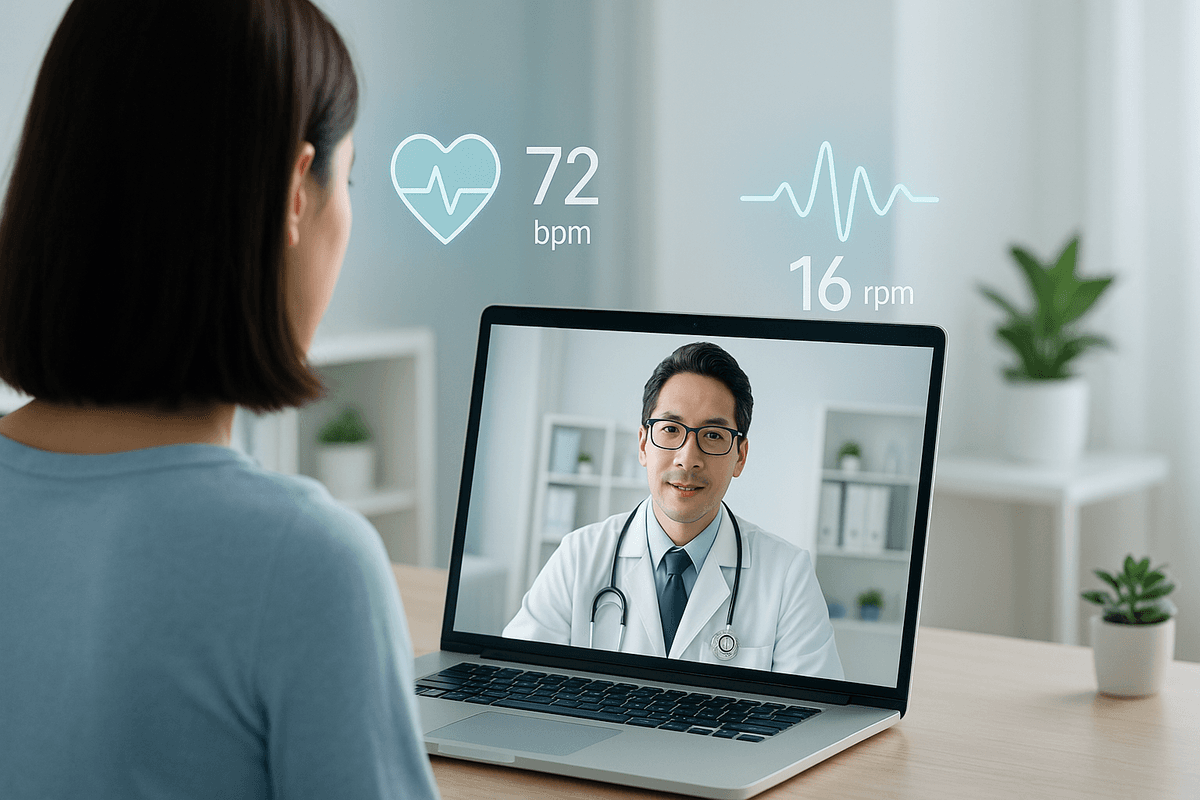
Yes, telehealth can capture some vital signs without shipping hardware, but only some of them and only under the right workflow. Heart rate is the most mature no-device vital sign, respiratory rate is possible with guardrails, and blood pressure is still the place where marketing runs ahead of reality.
Why this question matters commercially
The appeal is obvious. Device programs create friction at every step: procurement, shipping, enrollment, pairing, support, replacement, and patient drop-off. When a telehealth team asks for vital signs without devices, what they usually mean is, "Can we get clinically useful physiology without turning operations into a hardware company?"
That is a smart question.
It is also the question that separates good virtual care products from glossy demos. A no-device workflow only helps if it reduces friction and preserves enough trust in the measurement to change what the clinician does next.
Which vital signs are realistic without extra hardware
Heart rate
This is the strongest use case today. Camera-based heart rate, whether from a smartphone or webcam, is well established under controlled conditions. The underlying methods are covered in rPPG technology how it works and camera heart rate clinical validation.
For a calm patient, sitting upright, in decent light, a front camera can often give a usable resting heart-rate estimate. This is why heart rate is the first metric most device-free telehealth products try to ship.
Respiratory rate
Respiratory rate is possible, but the workflow matters more. You need a stable clip, minimal talking, and quality checks that reject bad captures. We covered the physiology in PPG respiratory rate estimation, and the operational angle is similar to the issues discussed in contactless vital signs detection.
The problem is not that respiratory rate cannot be estimated. The problem is that clinical teams care about it most when the patient is anxious, talking, uncomfortable, or breathing irregularly, which is also when the camera signal gets worse.
Blood pressure
No-device blood pressure remains the weak link. Face-only camera blood-pressure claims are still far from the trust level most clinicians expect. There are interesting research paths, but a telehealth program should not assume it can replace a cuff with a webcam and keep the same clinical confidence. Read PPG blood pressure estimation methods if you want the technical reasons.
Oxygen saturation
This is another area where claims need restraint. Standard RGB cameras do not give you the same physics as dedicated pulse oximetry. The farther a product drifts toward "we can replace a pulse ox with video," the more skeptical you should get.
Where no-device telehealth vitals actually help
The best use cases are the ones where some physiologic context is better than none, but the decision does not hinge on a single exact number.
Virtual urgent care intake. A pre-visit camera capture can give the clinician a resting heart rate, a respiratory estimate, and a signal-quality flag before the call starts.
Behavioral health and coaching. For stress, pacing, breathing exercises, or medication follow-up, low-friction physiology can improve engagement without forcing the patient into a hardware setup.
Primary care follow-ups. Routine check-ins often happen with zero vitals because the patient is at home and no device is available. Device-free measurement can raise the floor.
Post-discharge touchpoints. Early follow-ups after discharge often happen before remote kits are delivered. A smartphone-based capture can fill that gap.
Commercial pilots and top-of-funnel experiences. Device-free onboarding lowers dropout. That alone can make it valuable if the claims stay honest.
Where the model breaks
The common mistake is assuming a good consumer onboarding flow is the same thing as a good clinical measurement strategy.
No-device telehealth usually struggles in:
- hypertension care that depends on cuff-validated blood pressure
- cardiology programs where waveform-level rhythm confidence matters
- pulmonary care where respiratory distress changes the breathing pattern during capture
- hospital-at-home programs that need dependable repeated measurements under messy home conditions
- elderly or low-digital-literacy populations who may struggle with setup or framing
In other words, no-device vitals are usually better as an adjacent layer than as the backbone of a serious monitoring program.
The right deployment model is staged, not absolute
A lot of operators frame this as a binary choice between shipping hardware and shipping nothing. That is the wrong model. The better model is staged measurement.
For example:
- first visit: camera-based heart rate and guided respiratory capture
- if signal quality is poor: repeat capture or staff-observed fallback
- if the care plan depends on blood pressure or oxygen saturation: route the patient to a cuff or dedicated pulse oximeter
- if the condition is chronic and ongoing: graduate the patient into a device-supported RPM path
That tiered approach lets telehealth teams use low-friction capture where it helps and preserve clinical rigor where it matters. It also avoids the dumbest outcome of all, which is buying a device-free platform and then quietly reintroducing manual workarounds for every important patient.
What implementation teams should watch in practice
If you are evaluating these systems operationally, watch the boring metrics, not just the accuracy headline.
Look at:
- capture completion rate
- retake rate
- percentage of sessions rejected for poor quality
- clinician trust and documentation behavior
- how often the result changes triage or follow-up
- whether patients without devices actually complete visits at higher rates
Those numbers tell you whether the technology is helping the care model or just decorating it. In many programs, the real win is not perfect measurement. It is getting from zero vitals to at least one reliable signal without creating a support nightmare.
The workflow lesson most teams learn late
The algorithm is only half the product.
A telehealth vital-sign capture is a workflow problem made of:
- patient instructions
- browser compatibility
- camera permissions
- network quality
- compression and frame drop behavior
- retake logic
- escalation when quality is poor
- clinical documentation rules
If those pieces are weak, the underlying model does not matter. This is why rPPG video conferencing vital signs is worth studying. Video calls are hostile signal environments. Compression, jitter, virtual backgrounds, and auto-exposure can degrade what looks like a simple webcam measurement.
A better way to think about ROI
The buyer question should not be, "Can this technology measure vitals without devices?"
It should be:
- Which vital signs can it measure well enough for our care model?
- Does it improve completion and access compared with doing nothing?
- Where do we still need shipped or clinic-grade hardware?
- What happens when the signal is poor or clinically implausible?
A device-free vital-sign layer can produce real ROI by lowering activation friction, improving intake completeness, and making virtual visits feel more clinical. But it only works when the care pathway is designed around what the technology can and cannot do.
What the literature supports, and what it does not
The repo's existing source set already tells a pretty clear story.
Camera-based heart-rate measurement is the most mature piece. Contactless respiratory rate estimation is promising for controlled spot checks. Broad telehealth studies suggest there is real value in device-free capture, but also point out subgroup performance issues and the need for strong validation. Blood pressure remains the place where evidence is weakest and overclaiming risk is highest.
That means a sensible product roadmap usually looks like this:
- start with heart rate
- add respiratory rate with quality gating
- use confidence scores and retakes
- reserve blood pressure for cuff-based or separately validated flows
- avoid turning one success case into a blanket clinical claim
My take for operators and buyers
If you run a telehealth service, you should absolutely explore device-free vital signs. The upside is real: lower friction, faster activation, better completion, and fewer visits with zero physiology attached.
But do not make the lazy leap from "usable in a pilot" to "suitable as a general replacement for home devices." That leap is where companies get burned.
The stronger commercial position is narrower and more believable: use camera-based vitals to expand access, improve intake, and support low acuity decision-making. Keep regulated devices in the workflow where the medical decision really depends on precision.
That framing sells better over time because it survives contact with reality.
Bottom line
Telehealth vital signs without devices are real, but they are not evenly real across all vital signs. Heart rate is ready for many low-friction workflows, respiratory rate can help when the capture is controlled, and blood pressure still needs much more caution than most marketing pages admit.
If you build the workflow around that truth, device-free vitals can be genuinely useful. If you ignore it, you end up replacing hardware friction with measurement risk.
References
- Amelard R, Hodges M, Weenk M, et al. Feasibility of camera-based vital signs monitoring in clinical care. npj Digital Medicine. https://doi.org/10.1038/s41746-022-00606-z
- Tarassenko L, Villarroel M, Guazzi A, et al. Non-contact video-based vital sign monitoring using ambient light and auto-regressive models. Physiological Measurement. https://doi.org/10.1088/0967-3334/35/5/807
- Zhao F, Li M, Qian Y, Tsien JZ. Remote measurements of heart and respiration rates for telemedicine. IEEE Transactions on Biomedical Engineering. https://doi.org/10.1109/TBME.2017.2763660
- Yin W, Yang M, Zhang L, Zheng W. Respiratory rate and heart rate estimation from facial video. IEEE Access. https://doi.org/10.1109/ACCESS.2021.3118499
- Schrumpf F, Frenzel P, Aust C, et al. Assessment of remote photoplethysmography for camera-based blood pressure estimation. Sensors. https://doi.org/10.3390/s21124016
Frequently Asked Questions
- Can telehealth capture vital signs without external devices?
- Yes, some telehealth workflows can capture heart rate and respiratory rate with a phone or webcam alone. Blood pressure, oxygen saturation, and high acuity monitoring still usually require dedicated hardware or an in-person measurement path.
- Which vital signs work best without devices in telehealth?
- Heart rate is the best current candidate, followed by respiratory rate in controlled workflows. Blood pressure is still weak without a cuff, and oxygen saturation remains difficult to validate from standard RGB cameras.
- Is device-free telehealth good enough for routine care?
- For low acuity screening, follow-ups, behavioral health, and some chronic care check-ins, it can add useful physiologic context. It should not be treated as a full replacement for regulated home monitoring equipment.
- Why do telehealth teams want no-device vital signs?
- Because device distribution is expensive, setup is slow, patient compliance drops, and many visits happen before hardware can be delivered or paired. Camera-based capture can reduce that friction.
- What are the main failure points in no-device telehealth vitals?
- Poor lighting, motion, unsupported browsers, weak internet, codec compression, patient confusion, and overconfident clinical claims are the big ones.
- Should telehealth companies replace RPM kits with camera-based vitals?
- Usually no. The better strategy is to use camera-based vitals where they lower friction and reserve hardware for conditions where accuracy and reimbursement depend on validated measurements.