Tachycardia Detection on Smartwatches: Accuracy, False Alarms, and When to Trust PPG
How accurate are smartwatch tachycardia alerts? Learn when PPG is useful, why false alarms happen, and when ECG confirmation is needed for safer care decisions.
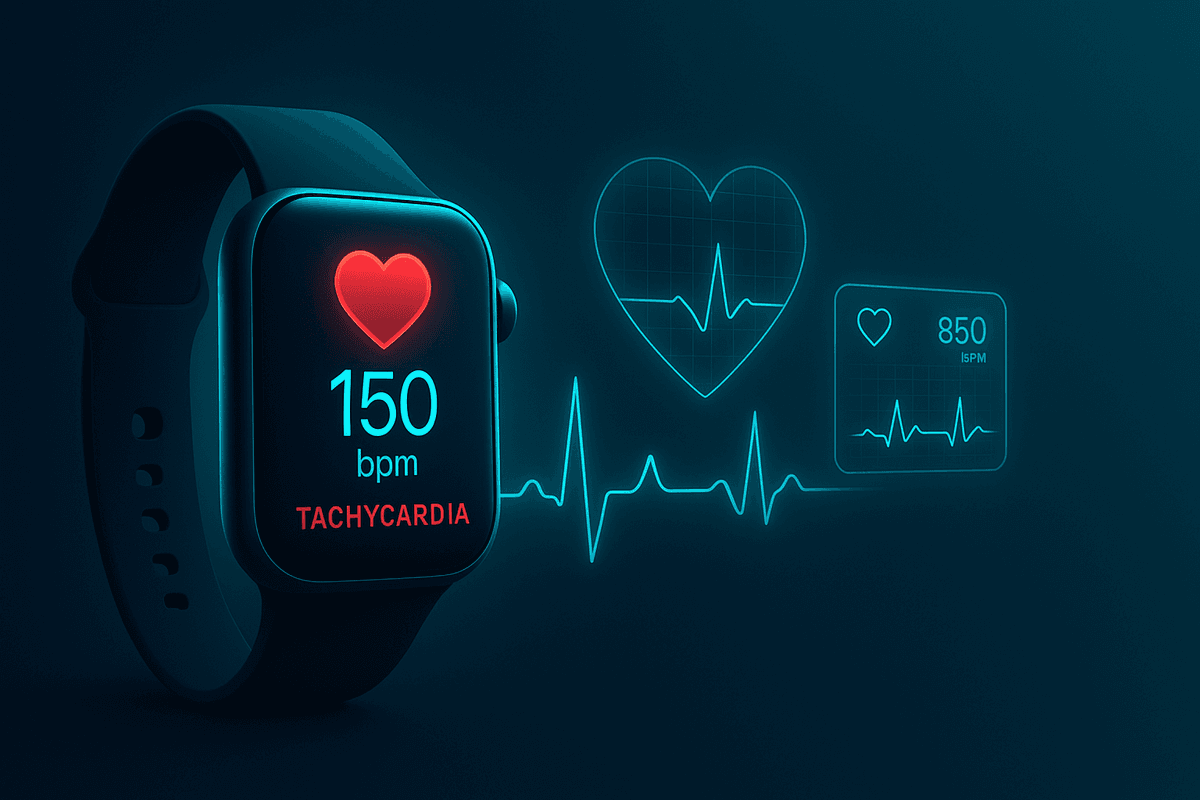
Smartwatches using photoplethysmography can detect episodes of rapid heart rate with reasonable sensitivity at rest, but tachycardia detection accuracy varies widely depending on threshold settings, motion and exercise, ectopy, and signal quality. When an alert reports sustained or symptomatic tachycardia, obtain ECG confirmation before definitive management; use smartwatch notifications as a screening signal, not a diagnostic test.
For broader context, browse the blog, learn hub, algorithms hub, conditions hub, and wearables hub.
Short answer for clinicians
- PPG-based tachycardia alerts are useful for screening and for symptom-rhythm correlation, especially at rest.
- False positives are common during exercise, motion, and when ectopic beats or poor perfusion confuse beat detection.
- Use duration filters, multi-beat confirmation, and signal quality gating to reduce false alarms.
- Trigger formal ECG if tachycardia is sustained, wide complex, associated with syncope, or if the patient has structural heart disease.
What PPG measures and why that matters for tachycardia
PPG monitors a pulsatile change in light absorption that follows blood volume pulses. It estimates beat-to-beat intervals indirectly by detecting pulse peaks. Unlike ECG, PPG does not record electrical conduction or QRS morphology, so it cannot reliably distinguish supraventricular from ventricular origin using waveform morphology alone. PPG is therefore well suited to count rate and detect irregularity, but limited for arrhythmia classification.
If you need a higher-level overview before diving deeper, start with our learn hub and wearables hub.
Why accuracy varies: thresholds, sample rate, and quality gating
-
Threshold selection. Many consumer devices use simple absolute thresholds, for example heart rate above 120 bpm, or irregularity detection. A low threshold increases sensitivity but raises false positive rate. A high threshold reduces nuisance alerts but can miss clinically relevant tachycardia in older or beta-blocked patients.
-
Duration and confirmation rules. Short transient bursts of high rate from artifact or single runs of premature beats will trigger alerts if devices do not require a minimum duration or consecutive beats. Requiring 10 to 30 seconds of elevated rate or multiple consecutive high-rate beats reduces false alarms.
-
Sampling rate and beat detection. Lower PPG sampling rates limit timing precision and may mis-estimate rapid rate. Devices that sample at higher rates and use robust peak detection maintain better performance for short tachycardia runs.
-
Signal quality indices. Good implementations gate alerts by perfusion index, waveform morphology match, or accelerometer-based motion detection. Quality gating prevents alerts when the PPG trace is unreliable.
Exercise confounds: high heart rate versus artifact
Physical activity produces two problems. First, true physiological heart rate rises with exertion and should not be interpreted as arrhythmic unless inappropriate for the context. Second, motion induces large artifacts that can mimic rapid pulses. During ambulatory activity, motion artifact often overlaps the cardiac band, making it difficult to separate true beats from spurious peaks.
Practical rules
- If an alert occurs during or immediately after exercise, treat it as expected physiologic tachycardia unless the rate is extreme or symptoms are severe.
- Devices that fuse accelerometer and PPG data to suppress motion artifact provide more reliable tachycardia alerts during light activity. For related methods, browse the algorithms hub.
Ectopy, sinus tachycardia, and how PPG can mislead
Ectopic beats cause irregular inter-beat intervals. A cluster of premature ventricular complexes or bigeminy can be misread as rapid or irregular rhythm, producing an alert for tachycardia or arrhythmia. PPG cannot show QRS width or axis, so it cannot determine if runs are wide complex ventricular tachycardia or supraventricular. In many cases PPG will detect a sudden increase in beat frequency but cannot adjudicate mechanism.
Clinical implications
- Short runs of accelerated ventricular ectopy may create a false alarm for sustained tachycardia.
- Repeated symptomatic alerts with consistent PPG morphology changes deserve expedited ECG review, even if each run is brief.
- Consider ambulatory ECG patch or event monitor for recurrent symptomatic episodes when diagnosis is uncertain.
Alert tuning: how vendors and clinicians can reduce false positives
Device manufacturers and clinical implementers can tune alerts along several dimensions:
- Absolute threshold. Tailor population-level default thresholds, but allow clinician or user-level customization for age, medications, and fitness.
- Minimum duration. Require sustained elevation for 10 to 30 seconds or more for an alert to fire.
- Beat confirmation. Require successive confirmed beats above threshold rather than a single outlier.
- Quality gating. Suppress alerts when perfusion index or SQI is below a validated cutoff.
- Context awareness. Reduce sensitivity during exercise or when accelerometer indicates vigorous motion.
- Symptom coupling. Offer a prompt to the user to record symptoms and, if triggered, record a short ECG strip when available.
Example alert strategy
- If HR >140 bpm for 5 seconds and SQI > threshold, then begin limited watch ECG capture.
- If HR >120 bpm for 20 seconds with symptoms, then escalate notification to clinician portal.
- If high HR occurs during detected high accelerometer activity and SQI is low, then suppress alert and log the event for passive review.
When to trust an alert and when to get ECG confirmation
Trust PPG alerts as a screening signal when they meet quality and duration criteria, but do not treat a PPG alert as a diagnosis. Prioritize ECG confirmation in these cases:
- Hemodynamic compromise, syncope, presyncope, or severe symptoms.
- New wide complex tachycardia pattern suggested by device ECG or history of structural heart disease.
- Recurrent symptomatic episodes affecting daily life or safety-sensitive tasks.
- Any sustained tachycardia above 150 to 180 bpm that is unexplained, especially at rest.
- When therapeutic decisions depend on rhythm origin, for example antiarrhythmic therapy, ablation referral, or device implantation.
Recommended workup after a concerning smartwatch tachycardia alert
- Obtain a 12-lead ECG if the event is ongoing or within a few hours of symptom onset.
- If ECG is normal and events recur, consider ambulatory ECG patch, often 14 day, or an event monitor to capture the episode.
- For infrequent but symptomatic events, consider an implantable loop recorder.
- Evaluate for reversible triggers: fever, dehydration, anemia, thyroid dysfunction, stimulants, and medication effects.
Interpreting device ECGs and recordings
Many smartwatches now offer single-lead ECG capture that provides additional information beyond PPG. Single-lead ECG helps distinguish AF, atrial flutter, and sinus tachycardia, but it still has limitations for ventricular arrhythmias and ischemia. If the device provides an ECG recording, forward it to cardiology with timestamps and the corresponding PPG trace when available.
For related background and validation context, see the blog, algorithms hub, and charts hub.
Operational recommendations for clinical programs
- Define triage rules that combine rate, duration, SQI, and symptom severity.
- Create pathways for expedited ECG review for high-risk alerts.
- Train staff to interpret device ECGs and to know device-specific limitations.
- Offer patient education: instruct users to avoid interpreting isolated alerts as emergencies and to seek care for severe or persistent symptoms.
Case vignette
A 58-year-old with hypertension receives a smartwatch alert of HR 150 bpm for 12 seconds while gardening. The device SQI was low and accelerometer data showed moderate wrist motion. The patient felt mildly lightheaded. Clinic review recommended obtaining a 12-lead ECG and a 7-day ambulatory patch. The ECG was normal. The patch captured frequent PVCs and short runs of non-sustained ventricular tachycardia, which prompted further electrophysiology referral. The smartwatch alert provided symptom-rhythm correlation that led to diagnosis.
Limitations, biases, and equity considerations
- Skin tone and perfusion affect PPG amplitude and SQI. Validation cohorts that underrepresent darker skin tones can overestimate accuracy in diverse populations.
- Older adults and patients with peripheral vascular disease may have lower perfusion and more false negatives.
- Device performance reported in controlled settings may not generalize to real-world ambulatory use.
FAQs
Can a smartwatch reliably tell me if I am having ventricular tachycardia?
No. PPG cannot determine QRS morphology. If a smartwatch suggests ventricular tachycardia, treat it as an alert that requires ECG confirmation.
How long does the high heart rate need to last before an alert is meaningful?
Alerts that require at least 10 to 30 seconds of sustained elevation with good signal quality are more likely to represent true tachycardia.
Are smartwatch tachycardia alerts useful during exercise?
They are less specific during exercise. Motion artifact and normal exercise tachycardia both increase alert frequency.
When should I refer a patient after a smartwatch alert?
Refer if alerts are recurrent, symptomatic, associated with syncope, or if the patient has structural heart disease.
Can alert tuning eliminate false positives entirely?
No. Tuning reduces nuisance alerts but cannot remove all false alarms because of physiological variability and measurement noise.
References
-
Perez MV, Mahaffey KW, Hedlin H, et al. Large-Scale Assessment of a Smartwatch to Identify Atrial Fibrillation. N Engl J Med. 2019;381:1909-1917. doi:10.1056/NEJMoa1901183
-
Nazarian S, Lam K, Darzi A, Ashrafian H. Diagnostic Accuracy of Smartwatches for the Detection of Cardiac Arrhythmia: Systematic Review and Meta-analysis. J Med Internet Res. 2021;23(8):e28974. doi:10.2196/28974
-
Caillol T, Strik M, Ramirez FD, et al. Accuracy of a Smartwatch-Derived ECG for Diagnosing Bradyarrhythmias, Tachyarrhythmias, and Cardiac Ischemia. Circ Arrhythm Electrophysiol. 2021;14:e009260. doi:10.1161/CIRCEP.120.009260
Frequently Asked Questions
- Can a smartwatch reliably tell me if I am having ventricular tachycardia?
- No. PPG cannot determine QRS morphology. If a smartwatch suggests VT, treat it as an alert that requires ECG confirmation.
- How long does the high heart rate need to last before an alert is meaningful?
- Alerts that require at least 10 to 30 seconds of sustained elevation with good signal quality are more likely to represent true tachycardia.
- Are smartwatch tachycardia alerts useful during exercise?
- They are less specific during exercise. Motion artifact and normal exercise tachycardia both increase alert frequency.
- When should I refer a patient after a smartwatch alert?
- Refer if alerts are recurrent, symptomatic, associated with syncope, or if the patient has structural heart disease.
- Can alert tuning eliminate false positives entirely?
- No. Tuning reduces nuisance alerts but cannot remove all false alarms because of physiological variability and measurement noise.