Remote Patient Monitoring Without Wearables
Can RPM work without shipping a watch or patch? A practical guide to camera-based monitoring, what can be done without wearables, and where hardware still earns its place.
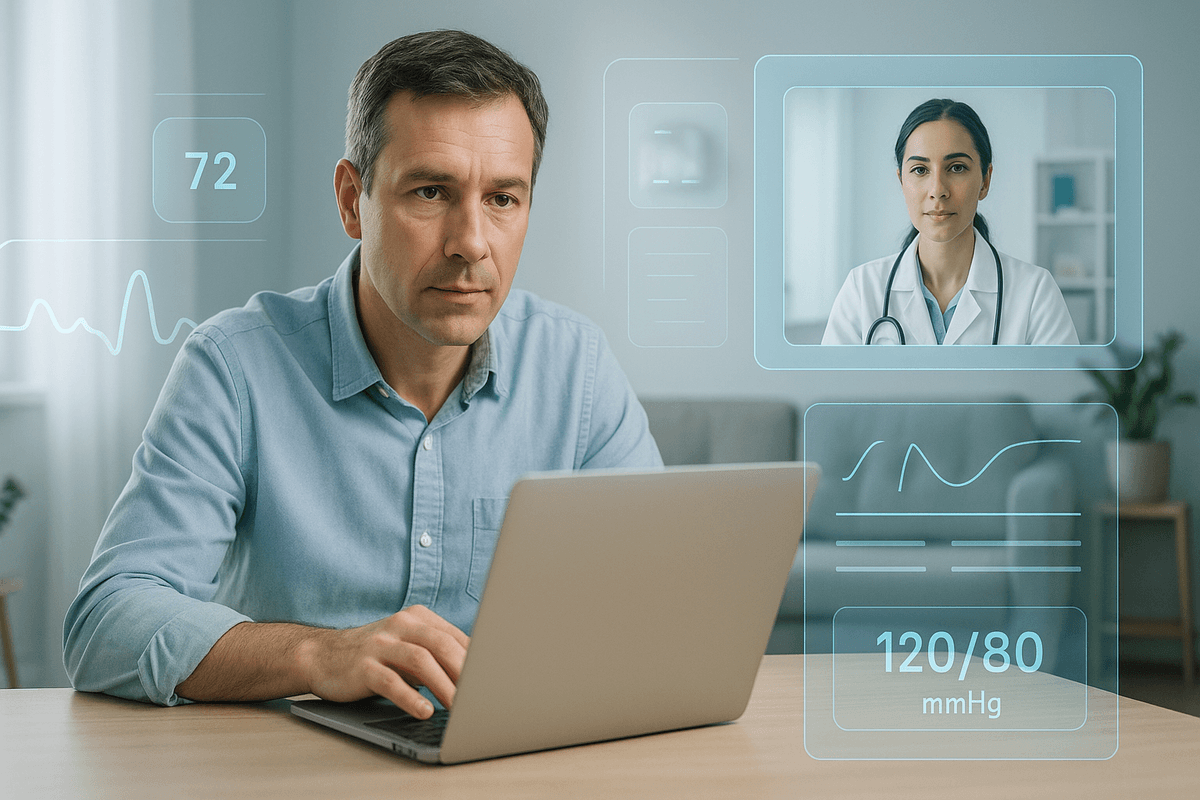
Yes, remote patient monitoring can work without wearables, but only if you are honest about what "work" means. If the goal is low-friction screening, symptom follow-up, and light-touch physiological check-ins, camera-based monitoring can be very useful. If the goal is continuous cardiopulmonary surveillance or medication titration off precise vitals, you will still need hardware.
That distinction gets lost because RPM buyers are tired of shipping boxes, chasing device setup, and watching half the patients disappear before day three. So the idea of "no wearables" sounds fantastic. Sometimes it is. Sometimes it is just a nicer way of saying "we cut the hard parts and hoped nobody noticed."
Why No-Wearable RPM Is Suddenly Attractive
Traditional RPM has real operational drag.
Someone has to provision devices, teach patients how to use them, troubleshoot Bluetooth pairing, replace batteries, chase missing data, and explain why the scale is on but not syncing. The clinical case for RPM can still be strong, especially in heart failure and post-discharge care, but the logistics are messy.
That is why camera-based workflows are getting attention. A patient already has a phone, laptop, or tablet. If the front camera can collect a few meaningful signals through rPPG, you remove shipping, charging, and pairing from the equation.
That is not just a UX improvement. It is an economics improvement.
For broader context, see remote monitoring of vital signs with PPG, contactless vital signs in telehealth, and rPPG in telehealth and remote monitoring.
What You Can Realistically Do Without Wearables
The strongest no-wearable RPM workflows are usually episodic rather than continuous.
Heart rate
This is the most realistic starting point. Camera-based pulse extraction has solid research support under decent conditions, and telehealth-focused studies show it can be feasible during structured remote encounters. Blackford and Ng demonstrated that non-contact heart-rate capture during telehealth visits is technically feasible when the workflow is controlled (DOI: 10.1007/s10439-021-02762-9).
Respiratory-rate estimation
Many camera systems infer breathing from subtle thoracic motion, facial color modulation, or waveform variability. This is promising for screening and remote check-ins, though still less robust than heart rate.
Trend capture before clinician review
A quick camera-based check can create useful context before a clinician call. Resting pulse higher than usual. Respiratory pattern looks more labored. Signal quality is poor because the patient cannot hold still. Even that last point can be informative.
Guided symptom escalation
No-wearable RPM does not have to mean physiology only. It can combine symptom surveys, medication adherence check-ins, and one or two optical measurements to decide whether a patient needs a nurse callback, an urgent visit, or a hardware device shipped next.
This is where the model gets interesting. You are not replacing every sensor. You are building a lighter first line of monitoring.
What You Usually Cannot Do Well Without Hardware
This is where product teams get sloppy.
Oxygen saturation
If oxygen saturation matters, do not pretend a normal webcam is enough. As discussed in can a camera measure oxygen saturation and ambulatory oxygen saturation monitoring, SpO2 is much harder than heart rate. A validated pulse oximeter still wins.
Blood pressure
Camera-based blood-pressure claims are still much less mature than the marketing suggests. Correlation plots are not the same thing as clinically usable blood pressure.
Continuous monitoring
A no-wearable model is usually patient-initiated or visit-linked. It does not magically become continuous just because the camera exists. If you need overnight monitoring, passive ambulatory capture, or automatic alerts from background collection, a wearable or bedside device still does real work.
Arrhythmia adjudication
PPG can help with screening, but if the clinical question is rhythm diagnosis, you eventually need ECG. That has not changed.
The Best Clinical Use Cases for RPM Without Wearables
Low-acuity follow-up
Patients recovering from a mild illness, medication change, or uncomplicated outpatient procedure can often complete brief camera-guided check-ins without extra devices.
Behavioral health and cardiometabolic coaching
Programs that care more about engagement and trend direction than minute-by-minute precision are good candidates. A quick pulse check tied to symptoms, sleep, or stress may be enough to support coaching.
Virtual triage and step-up pathways
This is probably the best commercial use case. Start with no-wearable capture. If the patient looks stable, stay lightweight. If risk rises, escalate to a pulse oximeter, cuff, patch, or in-person evaluation.
Access expansion
No-wearable RPM can reduce the time and cost required to get a patient into a monitoring workflow. That matters for populations who are less likely to manage device charging, setup, or return logistics.
The Best Commercial Use Cases
The most compelling business case is not "replace every wearable." It is "make RPM enrollment and early engagement far less painful."
Health systems and digital clinics routinely lose patients during setup. A camera-first workflow lets you start with a texted link instead of a shipped kit. That is faster, cheaper, and usually better for completion.
Then you tier the program:
- Tier 1: camera capture plus symptoms
- Tier 2: add simple peripherals if risk or persistence increases
- Tier 3: move high-risk patients to full device-based RPM
That model is much stronger than a fake all-or-nothing pitch.
What the Evidence Says About RPM Value
The evidence base for RPM overall is stronger than the evidence base for camera-only RPM specifically. That matters because some benefits come from the care workflow, not the sensor alone.
Koehler et al. showed that telemedical management in heart-failure patients can improve outcomes when monitoring is tied to active clinical intervention, not just passive data collection (DOI: 10.1136/bmj.n1477). Shan et al. reviewed digital monitoring programs in chronic disease and found that benefits are largest when device data is paired with organized clinical review rather than dumped into a dashboard nobody uses (DOI: 10.2196/36151).
That is the lesson many RPM buyers miss. The value is rarely the sensor by itself. The value is the workflow around it.
Camera-based RPM can absolutely fit that model, especially when it lowers friction at the start. But it still needs review rules, escalation pathways, and operational ownership.
What Vendors Get Wrong
Bad pitches usually fail in one of two directions.
Mistake 1: They undersell limitations
If a vendor implies that a front camera can replace pulse oximetry, blood-pressure cuffs, and wearables across the board, walk away. That is not mature thinking.
Mistake 2: They oversimplify deployment
The opposite mistake is acting like a browser link solves everything. It does not. You still need patient guidance, signal quality thresholds, documentation flow, consent, and a policy for missing or failed measurements.
Amelard et al. highlighted that camera-based vital signs performance varies meaningfully across patient groups and conditions, which is exactly why rejection logic and fallback plans matter (DOI: 10.1038/s41746-022-00606-z). McDuff and colleagues have also argued that non-contact vitals are advancing quickly, but the path forward depends on rigorous validation, not loose claims (DOI: 10.1126/sciadv.abn6498).
A Better Operating Model
If I were designing an RPM program without wearables today, I would not position it as hardware-free medicine. I would position it as friction-aware monitoring.
That means:
- start with a phone or laptop camera for fast onboarding
- collect heart rate and possibly respiratory features
- combine with symptoms and patient-reported context
- reject weak signals instead of manufacturing confidence
- escalate to hardware when the clinical question demands it
This model is simpler to explain to clinicians and safer to defend.
Who Should Not Use a No-Wearable Model as the Primary Plan
Some programs are just not good candidates.
- advanced heart failure with active medication titration
- COPD or pneumonia monitoring where SpO2 guides action
- post-op programs with real concern for respiratory compromise
- arrhythmia evaluation where ECG confirmation will matter quickly
- sleep-disordered breathing workflows that require overnight data
In those cases, a no-wearable layer can still help with intake or engagement, but it should not be the whole strategy.
My Take
Remote patient monitoring without wearables is real, useful, and probably underused. But it is best understood as a smarter front door, not a universal replacement.
If you want lower cost, faster deployment, and better early adherence, camera-based RPM is worth serious attention. If you want clinical certainty for oxygen saturation, blood pressure, or continuous surveillance, you are still living in hardware land.
That is not a failure of the camera model. That is just the current state of the evidence.
The winners in this market will be the teams that stop treating no-wearable RPM like a magic trick and start treating it like what it really is: a selective, high-leverage layer in a tiered monitoring system.
References
- Blackford EB, Ng JS. "Non-contact measurement of heart rate in telehealth visits." Annals of Biomedical Engineering (2021). DOI: 10.1007/s10439-021-02762-9
- Koehler F, et al. "Efficacy of telemedical interventional management in patients with heart failure." BMJ 374:n1477 (2021). DOI: 10.1136/bmj.n1477
- Shan R, et al. "Digital health technology and mobile devices for chronic disease management." Journal of Medical Internet Research 24(9):e36151 (2022). DOI: 10.2196/36151
- Amelard R, et al. "Feasibility of camera-based vital signs measurement in clinical populations." npj Digital Medicine (2022). DOI: 10.1038/s41746-022-00606-z
- McDuff D, et al. "Advancing non-contact vital sign measurement using a camera." Science Advances (2022). DOI: 10.1126/sciadv.abn6498
Frequently Asked Questions
- Can remote patient monitoring work without wearables?
- Yes, for some workflows. Camera-based measurements, questionnaires, and selective use of simple peripherals can cover more ground than many RPM buyers assume.
- What vitals can be monitored without a wearable?
- Heart rate and some respiratory-rate estimation are the most realistic today. Oxygen saturation and blood pressure usually still need dedicated hardware if the number will guide care.
- Is camera-based RPM enough for chronic disease programs?
- Sometimes as a front door, not always as the whole program. Higher-risk populations often still need cuffs, oximeters, scales, or ECG devices.
- Does no-wearable RPM improve patient adherence?
- It often improves onboarding and first-use completion because patients do not have to charge, pair, or wear another device.
- What is the biggest risk in no-wearable RPM?
- Overclaiming what a camera can do. Low-friction capture is valuable, but weak measurements should not be dressed up as clinical certainty.
- Should health systems replace all wearable RPM with camera monitoring?
- No. The better approach is usually a tiered model that uses camera capture where it helps and hardware where it matters.