How PPG Wearables Are Validated in Clinical Trials: Methods and Standards
How are PPG wearables validated clinically? Learn the study designs, statistical methods, and regulatory standards used to assess wearable heart rate device accuracy.
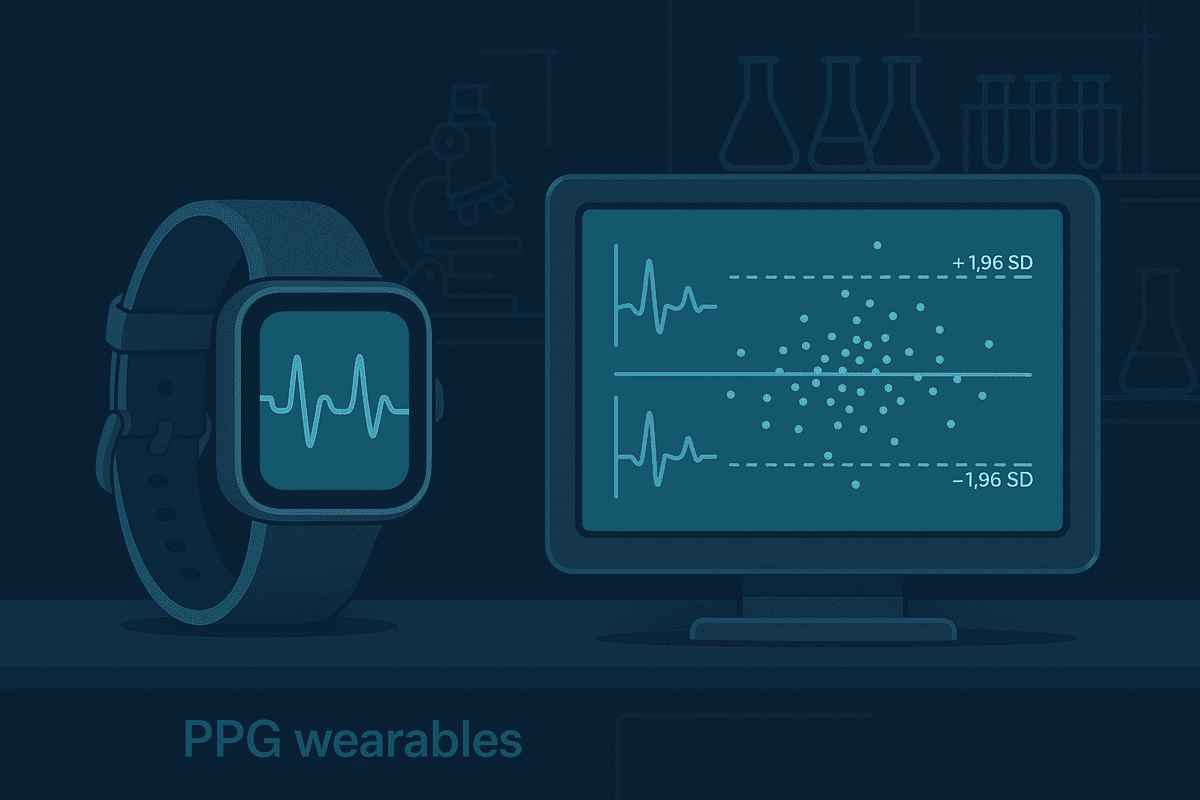
PPG wearable validation uses a well-defined methodology: the device under test is compared against a gold standard reference (ECG or arterial blood pressure) across diverse participants and activity levels. Statistical methods like Bland-Altman analysis reveal systematic bias and random error. Understanding these methods helps you assess the quality of validation claims you encounter.
Why Validation Studies Matter
The market is full of wearables claiming accurate heart rate and SpO2 monitoring. Without a standard for evaluating these claims, manufacturers can cherry-pick favorable conditions, use small unrepresentative samples, or report only the metrics that make their device look best.
Rigorous clinical validation studies follow standardized protocols and provide the kind of data that allows meaningful comparison across devices. When you read a wearable accuracy comparison, the quality of the underlying validation methodology determines how much you should trust the conclusions.
The Gold Standard: What PPG Is Compared Against
For heart rate validation: A 12-lead or multilead ECG provides the reference. ECG directly measures the electrical signal from each heartbeat with sub-millisecond precision. Chest strap monitors (like Polar H10) are sometimes used as a proxy reference but introduce slight additional error.
For SpO2 validation: Co-oximetry from arterial blood gas (ABG) sampling is the true reference. This directly measures the fraction of oxygenated hemoglobin in blood drawn from an artery. Clinical pulse oximeters are sometimes used as a secondary reference, though this creates a validation chain with accumulated error.
For blood pressure validation: The gold standard is intra-arterial pressure measured through an arterial line. Non-invasive oscillometric blood pressure cuffs (NIBP) are used as practical references in studies where arterial line placement would be unreasonably invasive.
Key Statistical Methods in Wearable Validation
Bland-Altman Analysis
Bland-Altman analysis is the standard method for comparing two measurement techniques. Unlike correlation coefficients (which can be high even when devices disagree substantially), Bland-Altman explicitly examines the agreement between methods.
A Bland-Altman plot shows:
- X-axis: Mean of the two measurements (reference + device under test)
- Y-axis: Difference between the two measurements
From this plot, you can read:
- Bias: The average difference (systematic over or underestimation)
- Limits of Agreement (LoA): The range within which 95% of individual differences fall (bias ± 1.96 × standard deviation)
Wide limits of agreement mean the device is unpredictable even if the average bias is small. A device with a bias of 0 BPM but limits of agreement of ±20 BPM could be off by 20 BPM in either direction for any given reading.
Mean Absolute Error (MAE) and MAPE
MAE is the average of the absolute differences between device and reference values. It is intuitive and commonly reported but can mask important information about systematic bias.
MAPE (Mean Absolute Percentage Error) normalizes MAE by the reference value. Useful when comparing accuracy across different heart rate ranges. A 5 BPM error at 50 BPM (10% MAPE) is very different from 5 BPM at 150 BPM (3.3% MAPE).
Correlation Coefficients
Pearson or Spearman correlation (r or ρ) measures how well device and reference measurements move together. However, high correlation does not mean good accuracy. Two devices can show r > 0.9 while one consistently overestimates the other by 15 BPM. Correlation tells you about the relationship pattern, not the agreement.
Validation papers that only report correlation without Bland-Altman or MAE data are incomplete.
Activity Protocol Design in Validation Studies
A good validation study tests the device across a range of conditions that represent real-world use. For heart rate wearables, this typically includes:
Resting phases: Supine, sitting, standing. Provides baseline accuracy before exercise effects occur.
Graded exercise: Treadmill or bicycle ergometer with incremental intensity increases. Allows analysis of how accuracy changes with intensity.
Vigorous exercise: High-intensity phases that reveal motion artifact problems.
Recovery: Heart rate decreasing after exercise. Tests whether the device accurately tracks dynamic changes, not just steady-state values.
Activities of daily living: Walking, stair climbing, light tasks. Tests ecologically valid conditions.
The best studies include a "free-living" component where participants wear the device for 24-48 hours during normal activities. This reveals accuracy under real-world conditions that controlled protocols may miss.
Population Diversity Requirements
A validation study is only as generalizable as its population. Historically, most wearable validation studies were conducted on young, healthy, predominantly light-skinned individuals. This created systematic overestimation of accuracy for broader populations.
Key demographic factors that affect PPG accuracy and should be represented in validation studies:
Skin tone: Fitzpatrick scale 1-6. Skin tone significantly affects optical PPG accuracy through melanin's effect on light absorption.
Age: Older adults have different skin thickness, capillary density, and cardiac physiology. Wearables validated only in young adults may underperform in elderly populations.
Body composition: Adipose tissue and muscle mass affect wrist optical pathlength. Very slim wrists and very thick wrists both present different sensor contact challenges.
Medical conditions: Arrhythmias, peripheral vascular disease, anemia, and other conditions affect both heart rate patterns and optical signal quality.
Wrist size and hair: Affect sensor contact and optical interference.
The IEEE 11073-40102 standard for wearable heart rate monitors now explicitly recommends diverse populations in validation studies.
Regulatory Considerations for PPG Wearables
Consumer wellness devices (no medical claims): No clinical validation required. The device must be safe (electrical safety standards, biocompatibility if skin-contacting) but accuracy is not regulated. This is how most smartwatches and fitness trackers are sold.
De Novo / 510(k) FDA clearance for specific claims: If a manufacturer wants to claim the device can diagnose AFib, detect hypoxemia, or make other medical claims, they need FDA clearance. This requires clinical validation data demonstrating accuracy and safety.
CE Marking (European Union): Similar tiered system. Wellness devices require minimal documentation; medical devices (Class I, II, III) require progressively more stringent clinical evidence.
The FDA regulatory status of remote PPG article discusses the regulatory landscape for camera-based and wearable monitoring devices in detail.
ISO and IEEE Standards for Wearable Accuracy
Several standards are relevant to PPG wearable validation:
IEEE 11073-40102: "Health informatics — Device interoperability — Ambient assisted living — Wearable heart rate monitor requirements." Defines performance and communication requirements for wearable HR monitors. The accuracy requirement is MAPE ≤ 10% at rest and during light activity.
ISO 80601-2-61: SpO2 accuracy requirements for pulse oximeters. Requires a root-mean-square difference of ≤ 3% relative to co-oximetry over the range 70-100% SpO2. Consumer wearables typically aim to meet this for spot-check SpO2 but are not required to.
ANSI/AAMI EC13: Cardiac monitors and ECG equipment performance standard. Relevant as a benchmark for how electrical heart signal monitors (chest straps) compare to optical devices.
See PPG IEEE and ANSI wearable testing standards for a comprehensive breakdown of the standards landscape.
What Good vs. Poor Validation Looks Like in Published Studies
Signs of a rigorous validation study:
- Criterion measure is ECG or co-oximetry (not just "another wearable")
- Multiple activity levels tested systematically
- N ≥ 20 subjects with diverse demographics
- Bland-Altman analysis reported with limits of agreement
- Conflicts of interest disclosed; ideally no manufacturer funding
- Pre-registered study protocol
Signs of a weak or manufacturer-biased validation:
- Tested only at rest
- N < 15, homogeneous sample
- Only correlation coefficients reported
- Conducted by manufacturer's own lab without independent replication
- Compared against another consumer wearable rather than ECG
When evaluating accuracy claims for any wearable, scrutinize the methodology as much as the headline accuracy number.
References
-
Shcherbina A, et al. "Accuracy in wrist-worn, sensor-based measurements of heart rate and energy expenditure in a diverse cohort." Journal of Personalized Medicine 7(2):3 (2017). doi:10.3390/jpm7020003
-
IEEE Standard 11073-40102: "Health informatics — Device interoperability — Wearable heart rate monitor." doi:10.1109/IEEESTD.2020.9307477
-
Bland JM, Altman DG. "Statistical methods for assessing agreement between two methods of clinical measurement." Lancet 327(8476):307-310 (1986). doi:10.1016/S0140-6736(86)90837-8
-
Gillinov S, et al. "Variable accuracy of wearable heart rate monitors during aerobic exercise." Medicine & Science in Sports & Exercise 49(8):1697-1703 (2017). doi:10.1249/MSS.0000000000001284
-
Van Laarhoven CJHCM, et al. "Methodological quality of smartwatch and wearable accuracy studies." npj Digital Medicine 6:1 (2023). doi:10.1038/s41746-022-00731-5
Frequently Asked Questions
- How are PPG wearables validated for clinical use?
- PPG wearables are validated by comparing their measurements against a criterion reference (usually ECG or arterial line) across diverse populations and activity levels. Studies use statistical methods like Bland-Altman analysis and report mean absolute error, limits of agreement, and MAPE.
- What standards govern PPG wearable validation?
- IEEE 11073-40102 defines requirements for wearable heart rate monitors. ANSI/AAMI EC13 covers ECG-based performance. For SpO2, ISO 80601-2-61 sets pulse oximeter accuracy standards. Consumer wearables are not required to meet these standards unless they make medical claims.
- What is Bland-Altman analysis and why is it used for wearable validation?
- Bland-Altman analysis compares two measurement methods by plotting the difference between them against their average. It shows systematic bias and random error. For wearables, it reveals whether the device consistently over or underestimates and how wide the variability is.
- What sample size is needed for a valid wearable accuracy study?
- For heart rate accuracy studies, regulatory guidance and published methods suggest at least 20-30 subjects across diverse demographics, multiple activity levels, and sufficient duration. For SpO2 validation per ISO 80601, at least 10 subjects with at least 5 hypoxic stimuli per subject.
- What is the difference between validation and verification in wearable clinical studies?
- Verification confirms the device performs as designed in a controlled setting. Validation confirms it performs accurately in real-world conditions with real users. Both are needed for clinical-grade certification.
- Do consumer wearables need FDA clearance for heart rate monitoring?
- No. Consumer wearables marketed as wellness devices do not require FDA clearance for general heart rate monitoring. They only need clearance if they make specific medical diagnostic claims, like AFib detection or SpO2 monitoring for clinical purposes.
- How long does a PPG wearable clinical validation study typically take?
- A rigorous validation study for a consumer wearable typically takes 6-18 months including study design, IRB approval, recruitment, data collection, and publication. Regulatory pathway validation for medical claims can take 2-5 years.