PPG Hypotension Prediction for Ward Monitoring: How Early Can Optical Signals Warn of Deterioration?
PPG hypotension prediction for ward monitoring uses waveform trends to identify hemodynamic decline earlier, but accuracy depends on context and validation.
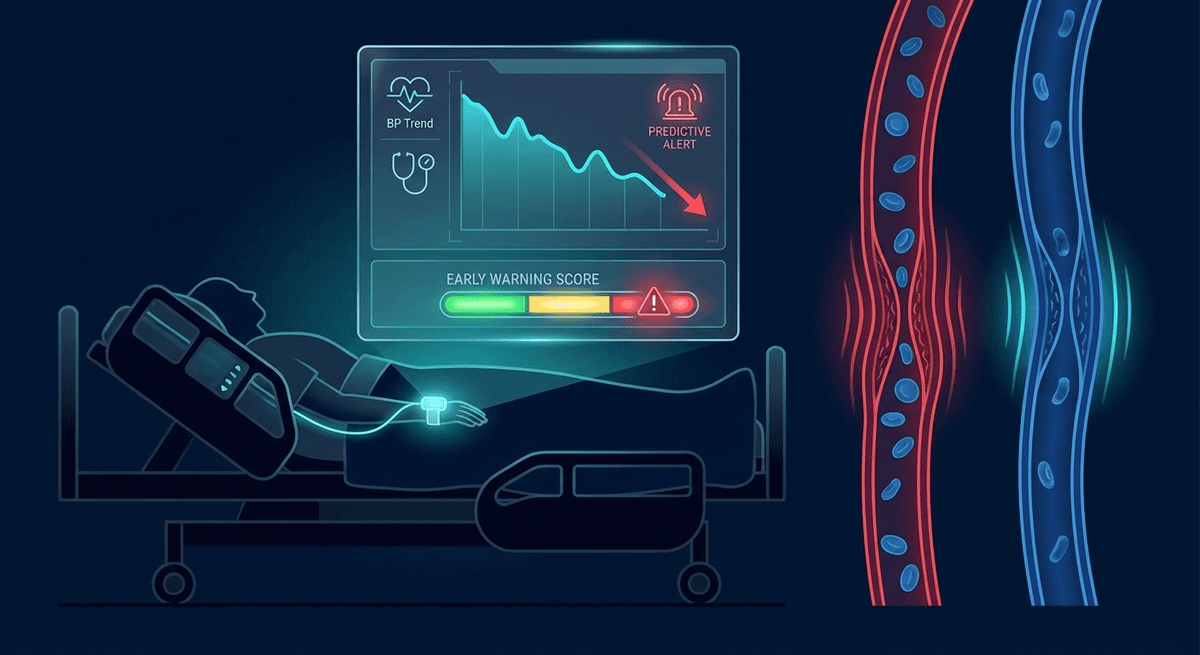
PPG hypotension prediction for ward monitoring uses pulse waveform changes to flag hemodynamic decline before an intermittent cuff check catches a low blood pressure reading. That makes it attractive in postoperative and step-down settings, where deterioration can begin quietly between vital-sign rounds, but the technology works best as an early warning layer, not a stand-alone diagnostic decision maker.
Definition box: Hypotension prediction means estimating the likelihood of an upcoming clinically relevant blood pressure drop before standard monitoring confirms it.
The reason this matters is operational as much as physiological. On many wards, blood pressure is still measured every few hours. A patient can become unstable long before the next cuff cycle.
Why ward hypotension is easy to miss
Unlike the ICU or operating room, standard wards often rely on intermittent vital signs. That creates blind spots.
A patient may develop:
- internal bleeding
- sepsis-related vasodilation
- medication-related hypotension
- postoperative volume loss
- autonomic instability
The nurse may not see a low blood pressure until the next scheduled set of vitals. Continuous PPG changes can fill some of that gap.
What changes in the PPG waveform before hypotension?
Hypotension is not one physiology. Still, several features often shift as circulation destabilizes.
Pulse amplitude
Peripheral pulse amplitude may fall as stroke volume drops or vasoconstriction intensifies.
Beat-to-beat variability
The waveform can become less stable, especially if autonomic compensation is active.
Upstroke and contour features
Changes in systolic rise time or waveform sharpness may reflect altered vascular loading and peripheral perfusion.
Respiratory modulation
In some settings, stronger respiratory-linked variability can hint at changing hemodynamics.
This is why waveform analysis is more promising than relying on a single derived number. The predictive signal often lives in combinations of subtle changes.
How is this different from cuff blood pressure monitoring?
A cuff gives an intermittent estimate of blood pressure. PPG gives a continuous view of the peripheral pulse waveform. They answer different questions.
A cuff tells you what the pressure is at the time of measurement. PPG may tell you whether the pulse behavior is drifting in a way that suggests an upcoming problem.
That is why the best systems use PPG as an early warning feature, not a replacement for formal BP measurement.
Where the approach works best
Postoperative surgical wards
Post-op patients are a strong use case because bleeding, volume depletion, and analgesic-related hemodynamic changes can evolve between routine checks.
Step-down units
These patients are often too stable for ICU-level invasive monitoring but still unstable enough that gaps in surveillance matter.
Remote or understaffed settings
Continuous low-burden surveillance may help prioritize who needs immediate bedside reassessment.
This connects naturally to PPG postoperative monitoring and PPG patch sensor ambulatory monitoring.
Why prediction is harder than it sounds
This is where some hype creeps in.
Peripheral signals are indirect
PPG does not measure arterial pressure directly.
Many causes produce similar waveforms
Pain, anxiety, vasoconstriction, cold skin, motion, and true hemodynamic decline can all alter the optical pulse.
Calibration across patients is difficult
A waveform pattern that signals decline in one patient may be normal in another.
Ground truth is imperfect on the ward
If cuff readings are sparse, it becomes harder to label exactly when hypotension truly began.
Best use in clinical systems
The strongest design is not a single red alarm. It is layered surveillance.
A useful system might combine:
- continuous PPG features
- intermittent BP readings
- heart rate trends
- respiratory rate
- posture or movement context
- nursing workflow rules
That gives the PPG waveform a role it can realistically play: early suspicion.
Practical takeaway
PPG hypotension prediction is promising because it addresses a real monitoring gap on the ward. The concept is physiologically plausible and operationally useful. The caution is that it should guide attention, not replace blood pressure confirmation.
In plain language, it is a smarter knock on the door, not the final diagnosis.
FAQ
Can PPG predict hypotension before blood pressure drops are measured?
In some monitored settings, PPG waveform trends can signal hemodynamic instability before a cuff reading captures a low blood pressure event.
Why is ward hypotension hard to catch?
Because intermittent cuff checks leave long gaps, and blood pressure can worsen between routine vital sign rounds.
What parts of the PPG waveform change before hypotension?
Pulse amplitude, beat-to-beat variability, upstroke characteristics, and respiratory modulation can all shift as circulation becomes less stable.
Is PPG hypotension prediction ready for independent clinical use?
Not as a standalone decision tool. It is most useful as an added surveillance layer within a broader monitoring system.
Where is this approach most useful?
It is most useful in postoperative floors, step-down units, and remote ward settings where intermittent cuff checks can miss early decline.
What a useful alert should look like on the ward
A good hypotension prediction alert should not fire on every weak pulse waveform. It should combine sustained pattern change, signal quality confidence, and escalation logic tied to workflow.
For example, a system might raise concern only when several risk features remain abnormal over a defined window and the patient is not simply moving or being repositioned.
Why operational design matters as much as model accuracy
Even a strong model fails if the alert reaches the wrong person, fires too often, or arrives without enough context to act. Ward monitoring succeeds when the system supports bedside reassessment, not when it floods staff with vague warnings.
Frequently Asked Questions
- Can PPG predict hypotension before blood pressure drops are measured?
- In some monitored settings, PPG waveform trends can signal hemodynamic instability before a cuff reading captures a low blood pressure event.
- Why is ward hypotension hard to catch?
- Because intermittent cuff checks leave long gaps, and blood pressure can worsen between routine vital sign rounds.
- What parts of the PPG waveform change before hypotension?
- Pulse amplitude, beat-to-beat variability, upstroke characteristics, and respiratory modulation can all shift as circulation becomes less stable.
- Is PPG hypotension prediction ready for independent clinical use?
- Not as a standalone decision tool. It is most useful as an added surveillance layer within a broader monitoring system.
- Where is this approach most useful?
- It is most useful in postoperative floors, step-down units, and remote ward settings where intermittent cuff checks can miss early decline.