PPG vs ECG Heart Rate Accuracy During Exercise: A Direct Comparison
How does PPG heart rate accuracy compare to ECG during exercise? This clinical comparison explains when PPG wearables diverge from ECG and why.
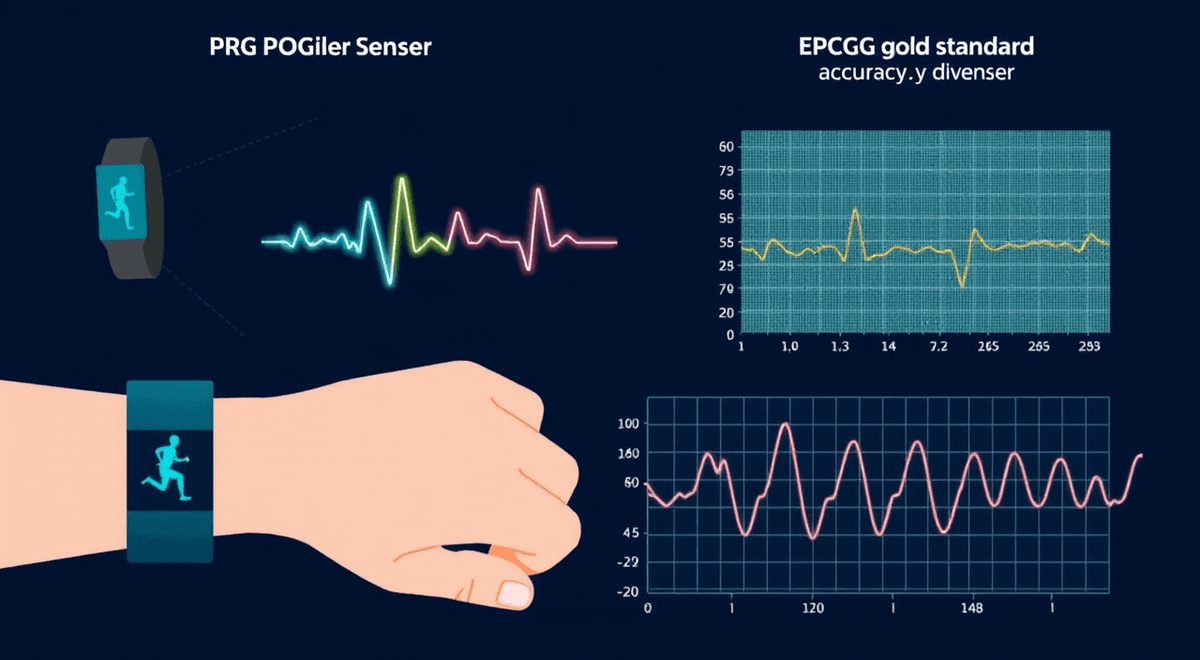
At rest, PPG heart rate and ECG agree within 2-5 BPM for most quality wearables. During vigorous exercise, the gap widens to 10-20 BPM because motion artifacts contaminate the optical signal while ECG remains unaffected. Understanding when and why this discrepancy occurs helps you use your wearable data intelligently.
The Fundamental Difference Between PPG and ECG
ECG and PPG measure heart rate using completely different physical phenomena:
ECG measures the electrical depolarization wave that propagates through the heart with each beat. Electrodes placed on the skin pick up microvolt-level electrical potentials. The QRS complex (the sharp spike in an ECG trace) is direct evidence of ventricular depolarization. Beat timing from ECG is precise to milliseconds.
PPG measures the volume change in blood vessels caused by the pressure wave from each cardiac contraction. As blood is pumped outward, capillaries and arteries briefly dilate. This dilates the blood column between an LED and a photodetector, reducing light transmission or increasing reflection. The timing of the peak in the PPG waveform corresponds to the systolic peak in blood pressure.
PPG is approximately 100-300 ms delayed from the ECG R-peak due to pulse transit time (the time for the pressure wave to travel from heart to wrist). For heart rate measurement this delay does not matter, since we are counting beats per minute. But for HRV measurement at the millisecond level, this delay and its variability introduce additional complexity. See PPG inter-beat interval accuracy for a deep dive on this.
At Rest: When PPG and ECG Agree
Under resting conditions, the fundamental accuracy advantage of ECG is largely moot. A good quality wrist PPG signal at rest is clean, the peaks are clearly identifiable, and the algorithm has little difficulty counting beats accurately.
Well-validated consumer wearables at rest typically show:
- Mean absolute errors of 1-4 BPM against ECG
- Intraclass correlation coefficients of 0.95-0.99
- Good Bland-Altman limits of agreement (within ±5 BPM for most devices)
The remaining resting error sources are mostly algorithmic: peak detection edge cases, occasional missed or double-counted beats, and the occasional invalid sample due to sensor contact issues.
For sleep and resting physiological monitoring, quality PPG wearables provide data that is clinically useful in many contexts, even if not identical to ECG.
What Happens to PPG Accuracy as Exercise Intensity Increases
The divergence between PPG and ECG grows predictably with exercise intensity:
Walking (HR ~90-110 BPM): Small divergence. Arm swing is slow and regular. Most wrist PPG devices maintain accuracy within 3-6 BPM.
Easy jogging (HR ~120-140 BPM): Moderate divergence begins. Arm swing increases. PPG devices typically maintain 5-8 BPM accuracy. Readings lag transitions (heart rate after stopping or starting still lingers).
Moderate running (HR ~140-160 BPM): Clear divergence visible in Bland-Altman plots. Mean errors of 7-12 BPM. Some cadence interference begins.
Vigorous running / HIIT (HR ~160-180+ BPM): Largest divergence. Mean errors of 10-20 BPM are common. Cadence lock occurs in many cases, where the PPG signal locks onto stride frequency (typically 160-180 steps/min) and the watch shows a stable but incorrect reading.
Sprint intervals and all-out efforts: Worst PPG accuracy. The rapid acceleration and deceleration of arm movement creates peak artifact. Simultaneous with peak cardiac intensity, making the most important data point the least reliable one.
The Lag Problem: PPG During Interval Training
Even when the absolute heart rate estimate is close to ECG, PPG shows a systematic lag during dynamic changes that ECG does not. This is particularly visible during interval training.
When you go from 50% effort to all-out sprint, your heart rate ramps up over 10-15 seconds. ECG tracks this ramp precisely. PPG wrist devices often show the heart rate still ramping when ECG shows it has plateaued, and then overshooting as you slow down.
This lag comes from:
- The algorithm using averaging over several beats to stabilize the reading (smoothing)
- The optical signal taking a few beats to adapt to changed blood flow dynamics
- Sweat accumulation during intensity changing the optical path length
For high-intensity interval training, the lag means you are often getting heart rate data that reflects the previous work interval while you are already in the next rest period (or vice versa). This makes zone-based interval decisions less reliable.
When PPG Data Is Good Enough for Exercise
The PPG-ECG gap during exercise matters differently depending on your use case:
Long-duration steady effort (marathon, long ride): PPG is often good enough. After the first few minutes of warmup, heart rate stabilizes and the PPG signal is more reliable at sustained intensity. The difference between PPG showing 148 BPM and ECG showing 152 BPM likely does not change your training decision.
Zone 2 training: PPG is usually reliable enough to determine whether you are in zone 2 versus zone 3, even with 5-7 BPM error, because the zones are broad (typically 20+ BPM ranges).
Precise interval work (e.g., target 165-170 BPM during intervals): PPG is inadequate. The lag and error mean you cannot reliably hit specific narrow targets. Use a chest strap.
Competition pacing: If you are pacing yourself in a race by heart rate zones, PPG error could lead to going out too hard or leaving effort on the table.
Post-exercise recovery monitoring: PPG shows the general recovery pattern (heart rate declining toward baseline) accurately enough for most purposes, with some lag.
Real-Time PPG Algorithm Challenges
The algorithms trying to extract heart rate from a noisy exercise PPG signal face a genuinely hard signal processing problem. PPG motion artifact removal algorithms must:
- Detect the PPG peaks (heartbeats) in a signal contaminated with motion noise
- Separate cardiac frequency from motion/cadence frequency when they overlap
- Handle rapid heart rate changes during interval transitions
- Do all of this in real-time on a low-power embedded processor
Modern approaches use accelerometer data fusion: the 3-axis accelerometer signal from wrist movement is used as a noise reference and subtracted from the PPG signal. Adaptive filters like LMS (LMS and NLMS in PPG) can substantially reduce motion artifact. Spectral methods using STFT for heart rate tracking can identify the dominant frequency component in the cleaned signal.
Despite these advances, exercise PPG remains meaningfully less accurate than ECG during vigorous activity. This is not a failure of algorithm design but a consequence of the physics of optical sensing.
Implications for Using Wearable Data in Research
Researchers using consumer wearable PPG data for exercise physiology studies must account for the ECG-PPG discrepancy. Using self-reported wearable data as if it were clinical-grade is a systematic error source.
Best practices for research contexts:
- Report the specific device and firmware version used
- Validate accuracy in your specific population and activity before relying on the data
- Use concurrent ECG reference measurement when precision matters
- Report Bland-Altman analysis and limits of agreement, not just correlation
- Consider using chest strap monitoring concurrent with wearable for important outcome measures
For a complete guide to clinical validation study design for PPG devices, see how PPG wearables are validated in clinical trials.
References
-
Cadmus-Bertram L, et al. "Wrist-worn consumer-grade device validity for step counting and heart rate." Journal of Physical Activity and Health 17(8):869-876 (2020). doi:10.1123/jpah.2019-0422
-
Hernando D, et al. "Validation of the Apple Watch for heart rate variability measurements during relax and mental stress in daily life." Journal of Medical Systems 42:159 (2018). doi:10.1007/s10916-018-1011-2
-
Bent B, et al. "Investigating sources of inaccuracy in wearable optical heart rate sensors." npj Digital Medicine 3:18 (2020). doi:10.1038/s41746-020-0226-6
-
Zhang Z, et al. "TROIKA: A general framework for heart rate monitoring using wrist-type photoplethysmographic signals during intensive physical exercise." IEEE Transactions on Biomedical Engineering 62(2):522-531 (2015). doi:10.1109/TBME.2014.2359372
-
Sviridova N, Sakai K. "Human photoplethysmography: new insight into chaotic characteristics of data from the finger tip." Physiological Measurement 36(5):1027 (2015). doi:10.1088/0967-3334/36/5/1027
Frequently Asked Questions
- How accurate is PPG heart rate compared to ECG during exercise?
- At rest, PPG and ECG agree within 2-5 BPM for most consumer devices. During moderate exercise, PPG error grows to 5-10 BPM. During vigorous exercise, PPG error can reach 10-20 BPM. ECG remains the gold standard regardless of intensity.
- Why is ECG more accurate than PPG for heart rate?
- ECG directly measures electrical signals from the heart, which are unaffected by movement, light, or tissue properties. PPG measures optical changes in blood volume, which are heavily affected by motion artifacts, skin pigmentation, and contact quality.
- Can PPG ever match ECG accuracy for heart rate?
- At rest and in controlled conditions, some consumer PPG devices can approach ECG accuracy (within 1-2 BPM). During vigorous exercise, the physics of optical sensing prevent PPG from matching ECG accuracy without supplementary sensors for motion artifact removal.
- What is the main source of error between PPG and ECG during exercise?
- Motion artifacts from limb movement are the primary source of discrepancy. Secondary factors include cadence lock (wrist PPG locking onto stride frequency instead of cardiac frequency) and signal quality issues from sweat and sensor contact changes.
- When does PPG show the largest error compared to ECG?
- The largest PPG-ECG discrepancy occurs during high-intensity interval training (HIIT), all-out sprints, and exercises with intense gripping or wrist movement. PPG accuracy is worst when heart rate changes rapidly during intervals.
- Can I use PPG data from a wearable to replace an ECG stress test?
- No. Clinical ECG stress tests capture detailed cardiac electrical information (ST segments, arrhythmia patterns, conduction abnormalities) that no consumer PPG device can provide. They serve completely different diagnostic purposes.
- What is the practical impact of PPG-ECG discrepancy during training?
- For zone-based training, the discrepancy often still leaves you in the correct zone even with 5-10 BPM error. For precise interval targets, it may push you into the wrong zone. During recovery detection, PPG lags ECG as heart rate drops post-exercise.