PPG Applications in Hemodialysis Monitoring: Fluid Status, Access Patency & Hemodynamic Tracking
**Hemodialysis patients undergo rapid fluid and electrolyte shifts during treatment sessions that create significant hemodynamic instability, and phot...
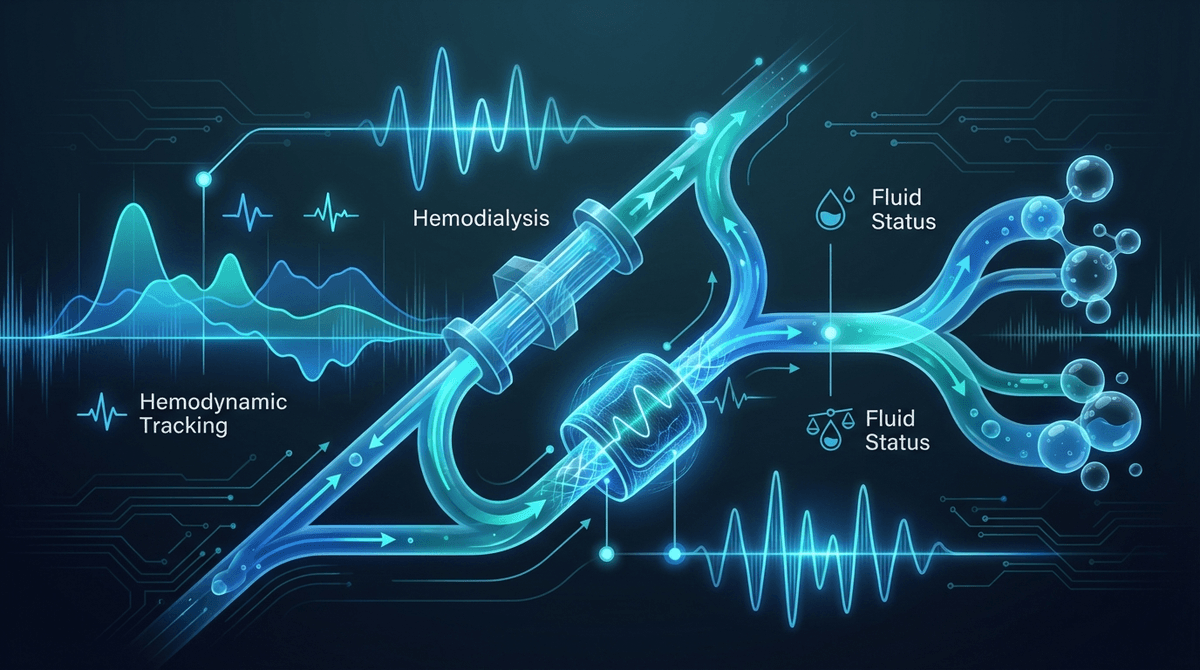
Hemodialysis patients undergo rapid fluid and electrolyte shifts during treatment sessions that create significant hemodynamic instability, and photoplethysmography (PPG) offers a non-invasive, continuous window into these physiological changes. The PPG waveform encodes information about blood volume, vascular tone, cardiac output, and peripheral perfusion that is directly relevant to the clinical challenges of dialysis management. This article reviews the current state of PPG-based monitoring in hemodialysis, covering fluid status assessment, vascular access surveillance, intradialytic hemodynamic tracking, and emerging applications that may transform dialysis care.
For foundational understanding of PPG signal generation and the physiological information encoded in the waveform, see our introduction to PPG technology. The signal processing techniques discussed here build on methods covered in our PPG signal processing algorithms guide.
The Clinical Need for Better Dialysis Monitoring
Approximately 3.4 million patients worldwide receive hemodialysis, with each patient typically undergoing 3-4 hour sessions three times per week. During each session, 2-4 liters of fluid are removed through ultrafiltration while blood is simultaneously cleaned of uremic toxins. This rapid fluid removal creates a fundamental hemodynamic challenge: the intravascular volume decreases faster than interstitial fluid can refill it, leading to intradialytic hypotension (IDH) in 20-30% of all sessions (Flythe et al., 2015; DOI: 10.1681/ASN.2014060535).
Current monitoring during dialysis relies primarily on intermittent blood pressure cuffs (typically every 15-30 minutes), online blood volume monitoring via hematocrit sensors, and clinical observation. These methods are either discontinuous, indirect, or reactive rather than predictive. PPG sensors, which can be applied non-invasively and provide continuous real-time data, address several gaps in current monitoring approaches.
The dialysis setting is actually favorable for PPG monitoring compared to ambulatory applications because patients are relatively stationary during treatment, minimizing the motion artifact challenges that plague wearable PPG in other contexts. This stationary condition means that PPG signal quality during dialysis sessions is typically excellent, with signal-to-noise ratios 10-20 dB higher than during ambulatory monitoring.
PPG-Based Fluid Status Assessment
Pulse Amplitude and Perfusion Index
The most direct PPG indicator of fluid status is the pulse amplitude, which reflects the pulsatile blood volume change in the measurement site. As ultrafiltration removes fluid, the intravascular volume decreases, cardiac preload drops, and stroke volume declines, all of which reduce the PPG pulse amplitude. The perfusion index (PI), defined as the ratio of pulsatile to non-pulsatile PPG components (AC/DC ratio), normalizes for sensor placement variability and provides a more robust fluid status indicator.
Kainerstorfer et al. (2014) conducted a study with 15 hemodialysis patients, measuring finger PPG continuously throughout dialysis sessions while simultaneously tracking blood volume changes with the Crit-Line monitor (DOI: 10.1088/0967-3334/35/12/2459). They found that the PPG pulse amplitude decrease correlated with ultrafiltration volume with r = 0.76 (p < 0.001). The perfusion index showed an even stronger correlation at r = 0.81 when baseline variability between patients was accounted for.
Importantly, the relationship between PPG amplitude and fluid removal is not linear. During the first 30-60 minutes of dialysis, sympathetic vasoconstriction partially compensates for volume loss, maintaining peripheral perfusion and PPG amplitude. Once compensatory mechanisms are exhausted, PPG amplitude drops more steeply. This nonlinear behavior actually provides clinically useful information: the inflection point where compensatory reserves are depleted corresponds to the onset of hemodynamic vulnerability.
PPG Waveform Morphology and Fluid Responsiveness
Beyond simple amplitude, the PPG waveform shape contains information about vascular compliance, peripheral resistance, and cardiac function that changes with fluid status. The second derivative of the PPG waveform (SDPPG, also called the acceleration plethysmogram) decomposes the pulse into five characteristic waves (a, b, c, d, e) whose ratios reflect arterial stiffness and vascular tone.
Sola et al. (2015) demonstrated that the b/a ratio of the SDPPG increased during ultrafiltration in a cohort of 28 dialysis patients, reflecting increased arterial stiffness as intravascular volume decreased. The d/a ratio, which correlates with peripheral vascular resistance, showed progressive changes that preceded blood pressure drops by an average of 18 minutes. These waveform features provide earlier warning of hemodynamic instability than simple amplitude monitoring.
Pulse wave variability induced by respiration, known as respiratory-induced plethysmographic variation (RIPV), is another morphological feature relevant to dialysis monitoring. RIPV reflects cardiac preload responsiveness; higher variability indicates that the patient is on the steep portion of the Frank-Starling curve and vulnerable to further volume depletion. Cannesson et al. (2008) established that plethysmographic variability index (PVi) values above 14% predicted fluid responsiveness with 81% sensitivity and 100% specificity in mechanically ventilated patients (DOI: 10.1093/bja/aen085). During dialysis, rising PVi values serve as an early warning that ultrafiltration rate should be reduced.
Intradialytic Hypotension Prediction
Early Warning Through PPG Features
Intradialytic hypotension (IDH) remains the most common acute complication of hemodialysis, occurring in 5-50% of sessions depending on the definition used and patient population studied. Nadir systolic blood pressure below 90 mmHg with symptoms is the most commonly used clinical definition (K/DOQI guidelines). Predicting IDH before it becomes symptomatic would allow preemptive interventions such as reducing ultrafiltration rate, administering saline bolus, or adjusting dialysate composition.
Soltani et al. (2020) developed a machine learning model using 14 PPG-derived features to predict IDH events 15-30 minutes before they occurred. Their feature set included pulse amplitude, perfusion index, pulse rate variability metrics (SDNN, RMSSD, LF/HF ratio), augmentation index, and SDPPG ratios. Using a random forest classifier trained on data from 45 patients across 180 sessions, they achieved 85% sensitivity and 78% specificity for IDH prediction at a 15-minute horizon. The most important features were the rate of change of perfusion index (accounting for 23% of feature importance) and the LF/HF ratio trend (18% of feature importance).
The physiological basis for PPG-based IDH prediction lies in the autonomic nervous system response to hypovolemia. As intravascular volume decreases, baroreceptor-mediated sympathetic activation increases heart rate, peripheral vascular resistance, and vascular tone. These changes are reflected in PPG through reduced pulse amplitude, altered waveform morphology, increased heart rate, and shifted heart rate variability toward sympathetic dominance (increased LF/HF ratio). When these compensatory mechanisms fail, blood pressure drops rapidly. The PPG captures the progressive exhaustion of compensatory reserves before the blood pressure threshold is crossed.
Continuous Blood Pressure Estimation During Dialysis
Pulse transit time (PTT) and pulse arrival time (PAT) measured from PPG correlate with blood pressure and can provide continuous BP estimates between cuff measurements. During dialysis, where blood pressure can change by 30-50 mmHg over minutes, continuous estimation is particularly valuable.
Meidert et al. (2018) evaluated PPG-based continuous blood pressure monitoring in 32 hemodialysis patients using a finger PPG sensor synchronized with an ECG monitor for PTT measurement. Calibrated against oscillometric cuff readings, the PTT-based systolic blood pressure estimates achieved a mean error of 2.3 mmHg with standard deviation of 9.8 mmHg across the stable phases of dialysis (DOI: 10.1007/s10877-017-0080-9). During rapid hemodynamic changes, accuracy degraded, with standard deviation increasing to 14.2 mmHg. Per-session recalibration using two cuff readings (at start and 1 hour into treatment) was necessary to maintain acceptable accuracy.
For deeper coverage of continuous BP monitoring methods, see our discussion of cuffless blood pressure technology and the underlying algorithms.
Vascular Access Monitoring
Arteriovenous Fistula Surveillance
Arteriovenous (AV) fistulas and grafts are the lifeline of hemodialysis patients, and their failure is a major cause of morbidity. Stenosis within the access circuit progressively reduces blood flow and eventually leads to thrombosis if not detected. Current surveillance methods include periodic Doppler ultrasound and access flow measurements (e.g., ultrasound dilution), but these are performed infrequently and miss interval changes.
PPG sensors placed over or adjacent to the AV fistula can detect hemodynamic changes associated with stenosis progression. The fistula creates a low-resistance shunt that generates characteristic high-flow, high-velocity signals detectable in the PPG waveform. As stenosis develops, flow resistance increases, altering the PPG waveform morphology.
Zanoli et al. (2018) investigated PPG-based AV fistula monitoring in 38 patients, placing PPG sensors on the fistula arm and the contralateral arm. They found that the ratio of PPG amplitude between fistula and non-fistula arms correlated with access flow rate measured by ultrasound dilution (r = 0.73, p < 0.001). When access flow dropped below the critical threshold of 500 mL/min (indicating hemodynamically significant stenosis), the PPG amplitude ratio decreased by more than 35% from baseline with 82% sensitivity and 79% specificity.
High-frequency analysis of the PPG signal (10-50 Hz) can also detect the audible bruit generated by turbulent flow through the fistula. Du et al. (2019) applied spectral analysis to high-sample-rate PPG recordings (1 kHz) from fistula sites and found that the spectral centroid of the 10-50 Hz band shifted toward higher frequencies as stenosis progressed, reflecting increased flow turbulence. This approach could enable continuous, automated fistula surveillance using a simple PPG sensor.
Steal Syndrome Detection
Dialysis access steal syndrome occurs when the AV fistula diverts blood flow away from the distal extremity, causing ischemia. Finger PPG is a natural tool for detecting steal because it directly measures distal perfusion. The classic diagnostic maneuver, the access compression test, involves temporarily occluding the fistula and observing whether distal PPG amplitude increases (indicating steal).
Modaghegh et al. (2015) used quantitative PPG measurements during access compression in 52 patients and found that a PPG amplitude increase of more than 20% during fistula compression had 91% sensitivity and 87% specificity for angiographically confirmed steal syndrome. The PPG-based diagnosis showed excellent agreement with the clinical gold standard (kappa = 0.78) and could be performed at the bedside with minimal equipment.
Oxygen Saturation Monitoring During Dialysis
Pulse oximetry, the most established clinical application of PPG, takes on particular importance during dialysis. Dialysis patients have a high prevalence of cardiovascular and pulmonary comorbidities, and intradialytic desaturation events are more common than previously recognized. Fluid overload in the interdialytic period causes pulmonary congestion that impairs gas exchange, and rapid fluid removal during dialysis can unmask or exacerbate ventilation-perfusion mismatch.
Campos et al. (2016) conducted continuous pulse oximetry monitoring in 78 hemodialysis patients across 468 sessions and found that 23% of sessions included at least one episode of SpO2 below 90% lasting more than 60 seconds. Most desaturation events (72%) occurred during sleep or drowsiness and would have been missed by standard clinical observation alone. The frequency of desaturation episodes correlated with interdialytic weight gain (r = 0.58, p < 0.001) and was an independent predictor of cardiovascular events at 12-month follow-up (hazard ratio 2.1, 95% CI 1.3-3.4).
For accurate SpO2 estimation in dialysis patients, several PPG-specific considerations apply. Uremic toxin accumulation can alter skin pigmentation and optical properties. Calciphylaxis and peripheral vascular disease, common in dialysis populations, may reduce peripheral perfusion and degrade PPG signal quality. Anemia, which is nearly universal in dialysis patients (typical hemoglobin 9-11 g/dL), reduces the ratio of pulsatile to non-pulsatile absorption and can affect the calibration of standard pulse oximetry algorithms. See our blood oxygen monitoring guide for more on SpO2 measurement principles.
Heart Rate Variability Analysis in Dialysis Patients
HRV analysis from PPG-derived pulse rate provides valuable insight into autonomic function in dialysis patients, a population with high prevalence of autonomic neuropathy. Reduced HRV is an established predictor of cardiovascular mortality in the general population, and this association is amplified in dialysis patients where cardiovascular disease accounts for approximately 50% of all deaths.
Rubinger et al. (2012) analyzed intradialytic HRV in 63 patients and found that pre-dialysis SDNN below 80 ms predicted intradialytic hypotension with 74% sensitivity and 71% specificity (DOI: 10.1093/ndt/gfr598). The LF/HF ratio showed characteristic shifts during dialysis: an initial increase reflecting sympathetic activation during early ultrafiltration, followed by a decline in patients who developed IDH as sympathetic reserve was exhausted.
Continuous PPG-based HRV monitoring could potentially guide individualized dialysis prescriptions. Patients with low baseline HRV may benefit from longer, gentler dialysis sessions with lower ultrafiltration rates, while patients with preserved autonomic function can tolerate more aggressive fluid removal. For detailed information on HRV metrics and their physiological interpretation, see our HRV chart by age reference.
Emerging Applications and Future Directions
Wearable Interdialytic Monitoring
The interdialytic period, typically 44-68 hours between sessions, is when most cardiovascular events occur in dialysis patients. Continuous PPG monitoring via wrist-worn devices during this period could provide early warning of dangerous fluid overload, arrhythmias, or hemodynamic instability. Pelter et al. (2021) demonstrated feasibility in a pilot study of 22 patients wearing PPG-enabled smartwatches continuously for 4 weeks, achieving 89% compliance and detecting previously undiagnosed atrial fibrillation in 3 patients (14%).
Machine Learning Integration
Deep learning models that integrate multiple PPG-derived features with clinical data (pre-dialysis weight, target ultrafiltration volume, dialysis vintage, comorbidities) show promise for personalized IDH prediction. Huang et al. (2022) developed a LSTM network trained on continuous PPG data from 156 patients across 2,340 sessions, achieving area under the ROC curve of 0.89 for IDH prediction at a 20-minute horizon. The model incorporated both time-domain PPG features and frequency-domain HRV metrics, with the learned temporal patterns outperforming static feature-based classifiers.
Point-of-Care Hemoglobin Estimation
Non-invasive hemoglobin estimation from multi-wavelength PPG (using the Masimo SpHb or similar technology) is particularly relevant for dialysis patients who require frequent hemoglobin monitoring. While current accuracy (typical limits of agreement of +/- 1.5 g/dL) is insufficient to replace laboratory testing, it can identify critical anemia or hemoconcentration trends during dialysis that guide erythropoietin dosing and iron supplementation.
Conclusion
PPG technology addresses multiple unmet monitoring needs in hemodialysis care. From fluid status assessment through perfusion index and waveform morphology, to IDH prediction via machine learning on PPG features, to vascular access surveillance through amplitude ratios and spectral analysis, PPG provides a rich, continuous, non-invasive data stream that complements existing monitoring modalities. The stationary nature of dialysis patients eliminates the motion artifact challenge that limits PPG in ambulatory settings, making dialysis an ideal clinical environment for advanced PPG analytics. As PPG signal processing algorithms continue to improve and wearable form factors become more practical, PPG-based dialysis monitoring is poised to move from research into routine clinical practice.