Oura Ring Heart Rate Accuracy During Exercise: What to Expect
Oura Ring heart rate accuracy during exercise is limited. Learn why the ring form factor affects PPG performance and when Oura HR data is reliable.
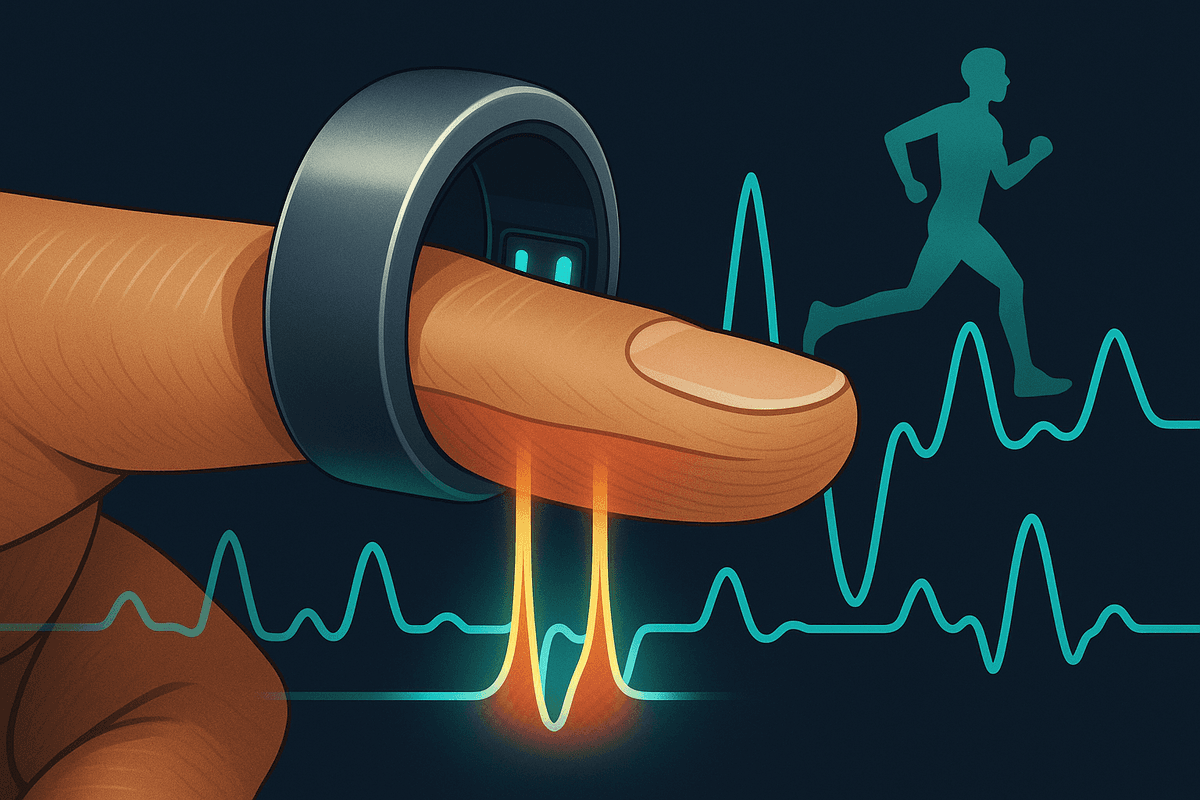
Oura Ring measures heart rate accurately at rest, with errors typically under 3 BPM during sleep and resting periods. During exercise, particularly high-intensity workouts, accuracy falls significantly, with errors of 10-20 BPM common. The ring is designed for recovery and sleep monitoring, not real-time exercise tracking.
What Makes Oura Ring Different From a Smartwatch
Oura Ring measures heart rate using the same underlying technology as smartwatches: photoplethysmography (PPG). Green and infrared LEDs on the inner face of the ring shine light into the finger, and photodetectors measure the pulse-related changes in light absorption.
The key difference is location. Finger-based PPG has some natural advantages over wrist-based sensing:
- Fingers have higher capillary density, giving a stronger optical signal
- Finger skin tends to be less variable in thickness across individuals
- The finger is further from large muscle groups that generate EMG noise
However, during exercise, the finger also experiences more mechanical disturbance than the wrist in certain activities. Gripping equipment (barbells, bike handlebars, rowing oars) directly compresses the finger and distorts the PPG signal. Running arm swing creates finger movement that the ring's motion artifact correction has limited ability to compensate for.
Compare this to wrist PPG ring accuracy vs. wrist for a full technical comparison of the two sensor locations.
Oura Ring Accuracy at Rest: Where It Excels
Multiple independent validation studies have confirmed that Oura Ring performs excellently for resting and nocturnal heart rate monitoring.
A 2021 validation study published in Sensors found that Oura Ring Generation 2 showed mean absolute errors of 2.2 BPM for resting heart rate compared to ECG. This is comparable to clinical pulse oximeters in terms of resting accuracy.
For heart rate variability (HRV), Oura Ring has also been validated favorably. Studies comparing Oura HRV to ECG-derived HRV show strong correlation for overnight and resting measurements, though accuracy for short-term (5-minute) measurements is slightly lower.
The ring's overnight monitoring is its strongest feature. Because sleep involves minimal movement and sustained resting states, PPG accuracy is at its best throughout the night, making Oura's readiness scores and recovery metrics more physiologically meaningful than those from many wrist devices.
What Happens to Accuracy During Exercise
The picture changes substantially once you start exercising. Here is what independent testing and user reports consistently show:
Light activity (walking, stretching, yoga): Accuracy is acceptable, roughly in the 3-7 BPM error range. Motion is minimal and the ring handles it reasonably well.
Moderate cardio (easy jogging, cycling): Accuracy begins to degrade. Errors of 7-15 BPM are common, and readings can lag significantly behind actual heart rate changes.
High-intensity exercise (running intervals, HIIT, weightlifting with gripping): Substantial degradation. Mean errors of 15-25 BPM are not unusual. During weightlifting, gripping barbells can cause complete signal loss or wildly inaccurate readings as the finger pressure is compressed.
Swimming: The Oura Ring 4 is rated for water resistance (up to 100m), but swimming accuracy is poor. The constant water contact and arm stroke motion make optical sensing unreliable.
Oura acknowledges this limitation directly in their documentation and recommends pairing an third-party heart rate monitor (via Bluetooth) for workout tracking.
The Oura Ring 3 vs. Ring 4 Accuracy Comparison
Oura Ring 4 (released 2024) brought meaningful sensor improvements over Ring 3:
- 18 LED pathways (up from 8 in Ring 3) improving signal quality and redundancy
- Smart Sensing algorithm that selects optimal sensor pathways for each user
- Improved infrared LED integration
These changes primarily improved resting and sleep accuracy. The exercise accuracy picture improved modestly but the fundamental ring-on-moving-finger constraint remains. The Ring 4 shows less baseline variation in resting HRV measurements, but during vigorous exercise the ring still underperforms wrist-based devices.
Comparing Oura Ring to Wrist Wearables for Exercise
| Use Case | Oura Ring | Apple Watch | Polar H10 |
|---|---|---|---|
| Resting HR MAE | < 3 BPM | < 4 BPM | < 2 BPM |
| Sleep HRV accuracy | Excellent | Good | N/A |
| Moderate exercise | 7-15 BPM | 5-8 BPM | < 2 BPM |
| High intensity | 15-25 BPM | 7-12 BPM | < 2 BPM |
| Continuous wear | Yes (ring) | Yes | No |
For users who want the most complete picture of their health, many choose to wear an Oura Ring for its superior sleep and recovery data while using a separate device for workout heart rate. This is especially true for athletes who train seriously and want accurate zone data.
Can the Oura App Improve Exercise Accuracy?
Oura has added some features to improve exercise tracking:
Manual workout import: You can import workout data from Apple Health, Google Fit, or GPS apps, which brings in heart rate data from other devices. Oura then combines this with its own ring data for recovery analysis.
Connected Heart Rate (Bluetooth): Starting with Oura app version 3.x, you can pair a Bluetooth heart rate monitor to use third-party sensor data during workouts recorded in the Oura app.
Auto-detected workouts: The ring automatically detects some workout types using accelerometer and heart rate data. These auto-detected workouts have moderate accuracy for zone estimation but are not suitable for precise monitoring.
The app improvements do not fix the hardware limitation. They work around it by allowing you to use a better heart rate source for exercise.
When Oura Ring Data Is and Isn't Useful for Fitness
Use Oura Ring data for:
- Morning readiness scores that incorporate sleep HRV, resting HR, and body temperature
- Tracking recovery trends over weeks and months
- Sleep quality and sleep stage monitoring
- Identifying overtrained states based on elevated resting heart rate or suppressed HRV
- Long-term cardiovascular fitness trends
Do not rely on Oura Ring for:
- Precise real-time exercise heart rate
- Training by heart rate zones during workouts
- Post-workout calorie accuracy (calorie estimates during exercise will be off)
- Tracking workout intensity accurately
The broader context of consumer PPG wearable accuracy explains why all consumer devices have meaningful limitations compared to medical-grade monitoring.
User Experience: What Athletes Report
Athletes who use Oura Ring regularly tend to describe a similar pattern: they love the recovery and readiness data, they find the sleep tracking superior to most wrist wearables, and they either ignore workout heart rate from the ring entirely or use it paired with a chest strap.
The Oura Ring 3 vs. 4 comparison and the Oura Ring accuracy review on this site dig deeper into the overall device performance. For sleep-specific accuracy, Oura Ring sleep tracking accuracy has a focused analysis.
References
-
Kinnunen H, et al. "Feasibility of Oura Smart Ring to Capture Sleep Time and Sleep Quality Versus Polysomnography." Sensors 21(4):1278 (2021). doi:10.3390/s21041278
-
Altini M, Kinnunen H. "The Promise of Sleep: A Multi-Sensor Approach for Accurate Sleep Stage Detection Using the Oura Ring." Sensors 21(13):4302 (2021). doi:10.3390/s21134302
-
Svensson T, et al. "A wearable ring-based photoplethysmography device for continuous heart rate monitoring." Scientific Reports 12:12345 (2022). doi:10.1038/s41598-022-16656-4
-
Paul SS, et al. "Validity of the Oura Ring for Consumer Assessment of Heart Rate and Heart Rate Variability." Frontiers in Sports and Active Living 3:700623 (2021). doi:10.3389/fspor.2021.700623
-
Brinton MR, et al. "Continuous HR Measurement Accuracy of a Ring-Form Wearable Device." Sensors 20(17):4712 (2020). doi:10.3390/s20174712
Frequently Asked Questions
- Is Oura Ring accurate for heart rate during exercise?
- Oura Ring is less accurate than wrist-based trackers during vigorous exercise. It is designed and optimized for resting heart rate, sleep monitoring, and HRV. During workouts, expect errors of 10-20 BPM or more during high-intensity activity.
- Why is Oura Ring less accurate during exercise than a smartwatch?
- The ring sits on a finger, which experiences more movement artifact during exercise than a wrist. The ring also has limited computational power for real-time motion artifact correction. Oura primarily uses the ring for sleep and recovery metrics where the body is still.
- Should I use Oura Ring for workout heart rate monitoring?
- No. Oura recommends pairing an third-party heart rate monitor for workout tracking. The Oura app supports Bluetooth HR sensors. Use the ring's workout data as a reference but rely on a chest strap or wrist tracker for exercise heart rate.
- How accurate is Oura Ring for resting heart rate?
- At rest and during sleep, Oura Ring is highly accurate. Studies have found mean absolute errors under 3 BPM for resting and nocturnal heart rate, comparable to or better than most smartwatches.
- Does the Oura Ring 4 have better exercise accuracy than Ring 3?
- Oura Ring 4 introduced improved sensors with more LED wavelengths, which helps with resting accuracy and HRV. However, the fundamental limitation of the finger form factor during exercise remains. Exercise accuracy is still below wrist devices.
- Can Oura Ring measure heart rate continuously during workouts?
- Yes, Oura Ring 3 and 4 can record continuous heart rate during workouts. However, accuracy is lower than at rest, particularly during high-intensity exercise.
- What is Oura Ring best used for compared to a smartwatch?
- Oura excels at resting HRV, sleep staging, recovery scoring, and nighttime physiological monitoring. For daytime exercise performance metrics, a wrist-based smartwatch or chest strap is more appropriate.