Is Camera Blood Pressure Accurate?
Camera-based blood pressure estimation is promising in research, but it is not yet a dependable replacement for cuff-based blood pressure in routine telehealth or clinical care.
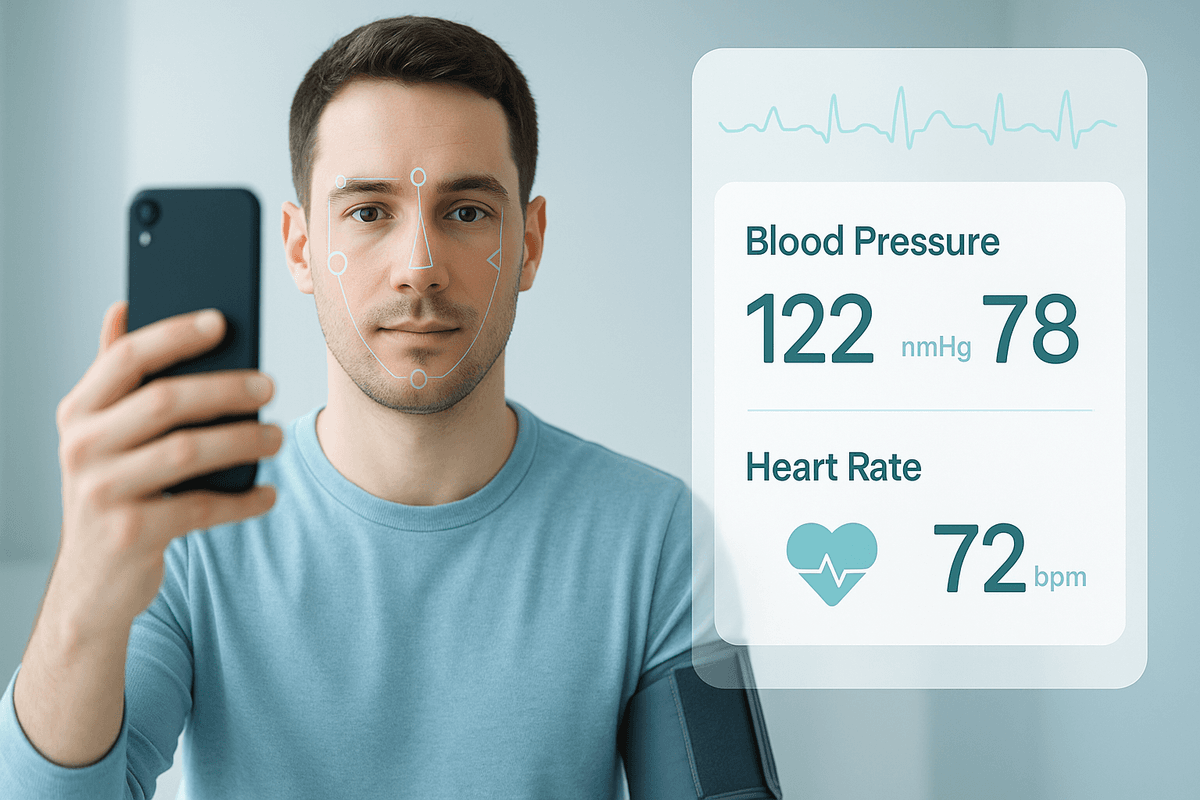
No, not in the way most clinicians mean the word accurate. Camera-based blood pressure can produce interesting estimates in research settings, and a few constrained smartphone methods look promising, but it is still not a dependable replacement for cuff-based blood pressure in routine telehealth or clinical care.
Why this question keeps getting overhyped
Blood pressure is the most commercially tempting vital sign in remote care. If a camera could replace a cuff, telehealth companies would remove one of their biggest sources of friction overnight.
That incentive has produced a lot of excitement and, frankly, a lot of sloppy framing. A paper that shows correlation with blood pressure or a decent result in a narrow calibration cohort often gets translated into "the camera measures blood pressure." That is too generous.
The more honest statement is that cameras may support blood-pressure estimation models under some conditions. That is a very different claim.
Why blood pressure is harder than heart rate
Heart rate is comparatively easy. A camera extracts a periodic pulse-related signal and finds its dominant rhythm. Blood pressure is not directly visible in the same way.
What camera systems usually do is infer blood pressure from features that are only indirectly related to it, such as:
- pulse transit or pulse arrival timing proxies
- waveform morphology features
- amplitude relationships
- demographic covariates
- prior calibration data
- machine learning models trained on population datasets
That means the model can look good in development and still fail when the user, lighting, disease state, posture, medication status, or vascular tone changes.
This is the same core issue discussed across PPG blood pressure estimation methods, PPG pulse transit time and blood pressure, and cuffless blood pressure when. The signal path is indirect, and indirect signals need stricter validation than most vendors want to admit.
Face-video blood pressure is the weakest category
Pure face-video blood pressure is the version that gets the most attention because it looks magical in product demos. Sit in front of a camera, hold still, and get systolic and diastolic numbers.
The problem is that face video has to fight every weakness of rPPG at the same time:
- motion sensitivity
- lighting variation
- compression artifacts
- skin-tone and perfusion variability
- camera hardware differences
- model drift across populations
Our internal source set already reflects this caution. The blood-pressure estimation article cites classical and machine-learning methods with nontrivial error, and the telehealth article points to a systematic assessment of camera-based blood-pressure estimation that highlights just how unresolved the field remains.
That should change how buyers read vendor claims. Correlation is not enough. A blood pressure product has to work across normotensive and hypertensive ranges, not just near the dataset mean.
The more interesting exception: touch plus camera smartphone methods
There is one important nuance here. Not all camera-based blood-pressure methods are the same.
Some smartphone systems ask the user to press a fingertip against the phone while the camera records a contact PPG signal. This is not the same as passive face video. It is closer to a phone-mediated oscillometric or pressure-modulated measurement.
That distinction matters because the best-known smartphone blood-pressure paper in our repo, Chandrasekhar et al., uses this kind of guided interaction rather than pure contactless face video. In that setup, the phone can extract more hemodynamic information than a standard webcam pointed at your face.
So if someone says "camera blood pressure works," the first follow-up should be: what kind of camera workflow are we talking about?
- passive face video
- face video plus calibration
- fingertip camera with flash
- fingertip camera plus applied pressure
- multi-sensor model with hidden cuff calibration
Those are not interchangeable product categories.
Validation is where most claims fall apart
A dependable blood-pressure method has to survive more than a neat scatterplot.
It needs:
- comparison against an accepted reference method
- performance across low, normal, and high blood-pressure ranges
- clear calibration requirements
- repeatability over time
- testing across age, skin tone, and comorbidity groups
- failure-rate reporting, not just success-case averages
This is why guideline documents matter so much. The 2023 European Society of Hypertension guidance on cuffless devices did not appear because the problem was solved. It appeared because the field needed stronger guardrails.
If a camera BP vendor cannot explain how they validated against recognized cuffless expectations, that is the signal, not the glossy UX.
What the current evidence suggests
The repo's source base supports a pretty consistent interpretation.
Classical waveform-feature approaches can extract BP-related information, but error remains meaningful.
Machine-learning approaches can produce attractive retrospective performance, especially on curated datasets, but generalization risk is high.
Smartphone pressure-assisted approaches are more promising than passive face video, because they inject additional information into the measurement.
Pure contactless telehealth blood pressure is still not ready to replace a cuff in most real care settings.
That last sentence is the one that matters operationally.
Calibration drift is the part vendors love to skip
Even when a camera blood-pressure method looks decent in a study, you still need to ask how long that accuracy lasts. A model that leans on calibration to a recent cuff reading may perform reasonably right after setup and then drift as posture, stress, medication timing, hydration, or vascular tone changes.
That is not a minor detail. It changes the entire operational value of the product. If the system needs frequent cuff recalibration to stay trustworthy, then the camera did not remove the cuff problem. It just wrapped the cuff problem in better UX.
This is especially important for hypertension management, where treatment decisions depend on repeated home measurements over time. A tool that looks accurate once but drifts between visits is worse than a slightly inconvenient cuff, because it creates false confidence.
The threshold problem
Blood pressure decisions often sit near thresholds: starting medication, adjusting dose, deciding whether a patient needs escalation, or determining whether a remote reading is acceptable. That means a seemingly modest error can still be clinically expensive.
A heart-rate estimate that is off by a few beats per minute may still be directionally useful. A blood-pressure estimate that is off enough to move a patient across a treatment threshold is a very different problem. This is why broad claims like "comparable to cuff" deserve skepticism unless the validation is deep, recent, independent, and transparent about failures.
What telehealth operators should do instead
If you run virtual care today, the sane strategy is not to wait for camera blood pressure to save you.
Use the tools that are already fit for purpose:
- cuff-based home BP for hypertension and medication titration
- camera-based heart rate for low-friction intake where appropriate
- camera-based respiratory rate as a secondary input, not a decisive one
- clear escalation to in-person or device-based measurement when BP matters
That mixed model is much more defensible than pretending one webcam can do the whole job.
Questions every buyer should ask
Before signing with a camera blood-pressure vendor, ask these directly:
- Was the method validated as passive face video, guided fingertip capture, or something else?
- Does it require calibration to a recent cuff reading?
- What are the systolic and diastolic errors across hypertensive patients, not just the average cohort?
- What percentage of sessions fail quality checks?
- Was the model tested across skin tone, age, cardiovascular disease, and medication variation?
- What clinical decisions do you explicitly say the measurement should not support?
A serious vendor will answer cleanly. A weak vendor will pivot back to AI branding.
My take
Camera blood pressure is one of those categories where technical possibility has outrun practical trust. The field is real. The signal science is interesting. Some hybrid smartphone methods may become useful. But if your question is whether a camera can deliver the kind of blood pressure accuracy clinicians already expect from a validated cuff, the answer today is still mostly no.
That is not a dismissal of the field. It is a boundary. And product teams that respect the boundary build better businesses than teams that market around it.
Bottom line
Camera blood pressure is promising research, not a broad clinical replacement for cuff-based blood pressure. Passive face-video estimation is the least trustworthy version, pressure-assisted smartphone methods are more plausible, and validation standards matter more than demo appeal.
If blood pressure changes the treatment decision, keep the cuff in the loop.
References
- Chandrasekhar A, Kim CS, Naji M, et al. Smartphone-based blood pressure monitoring via the oscillometric finger-pressing method. Science Translational Medicine. https://doi.org/10.1126/scitranslmed.aap8674
- Schrumpf F, Frenzel P, Aust C, et al. Assessment of remote photoplethysmography for camera-based blood pressure estimation. Sensors. https://doi.org/10.3390/s21124016
- Baruch MC, Warburton DE, Bredin SS, Cote A, Gerdt DW, Adkins CM. Pulse decomposition analysis and pulse wave morphology for cuffless blood pressure estimation. Journal of Clinical Epidemiology. https://doi.org/10.1016/j.jclinepi.2010.05.004
- Kachuee M, Kiani MM, Mohammadzade H, Shabany M. Cuffless blood pressure estimation algorithms from physiological signals. IEEE International Conference on Healthcare Informatics. https://doi.org/10.1109/ICHI.2017.45
- Stergiou GS, Palatini P, Asmar R, et al. Validation expectations for cuffless blood pressure devices. Journal of Hypertension. https://doi.org/10.1097/HJH.0000000000003305
Frequently Asked Questions
- Can a camera measure blood pressure accurately?
- Sometimes in a narrow research setup, but not with the consistency clinicians expect from a validated cuff. Camera-only blood pressure remains less mature than camera-based heart-rate estimation.
- Why is blood pressure harder than heart rate for a camera?
- Heart rate is a frequency estimation problem with a strong pulsatile signal. Blood pressure is an inferred hemodynamic variable that depends on calibration, vascular properties, waveform quality, and context.
- Are face-only camera blood pressure apps clinically reliable?
- Not yet. Some show correlations or small pilot results, but that is not the same as broad clinical reliability across age, skin tone, motion, disease state, and hypertensive ranges.
- Is smartphone touch plus camera blood pressure different from face video blood pressure?
- Yes. Guided touch-and-camera methods can behave more like a phone-based oscillometric test and are a different technical class from pure face-video estimation.
- Should telehealth programs replace cuffs with camera blood pressure?
- No. If blood pressure influences diagnosis, treatment, or reimbursement, telehealth programs should still use cuff-validated workflows unless a specific camera method has been validated for that exact use.
- What should buyers ask a camera blood pressure vendor?
- Ask for independent validation, error across blood pressure ranges, calibration requirements, failure rates, population diversity, and whether the product was tested against accepted cuffless BP standards.