Emotion Detection Wearables: Where PPG Works, and Where It Fails
An evidence-based guide to emotion detection wearables, where PPG helps, where it fails, and why reliable systems need multimodal context for real-world use.
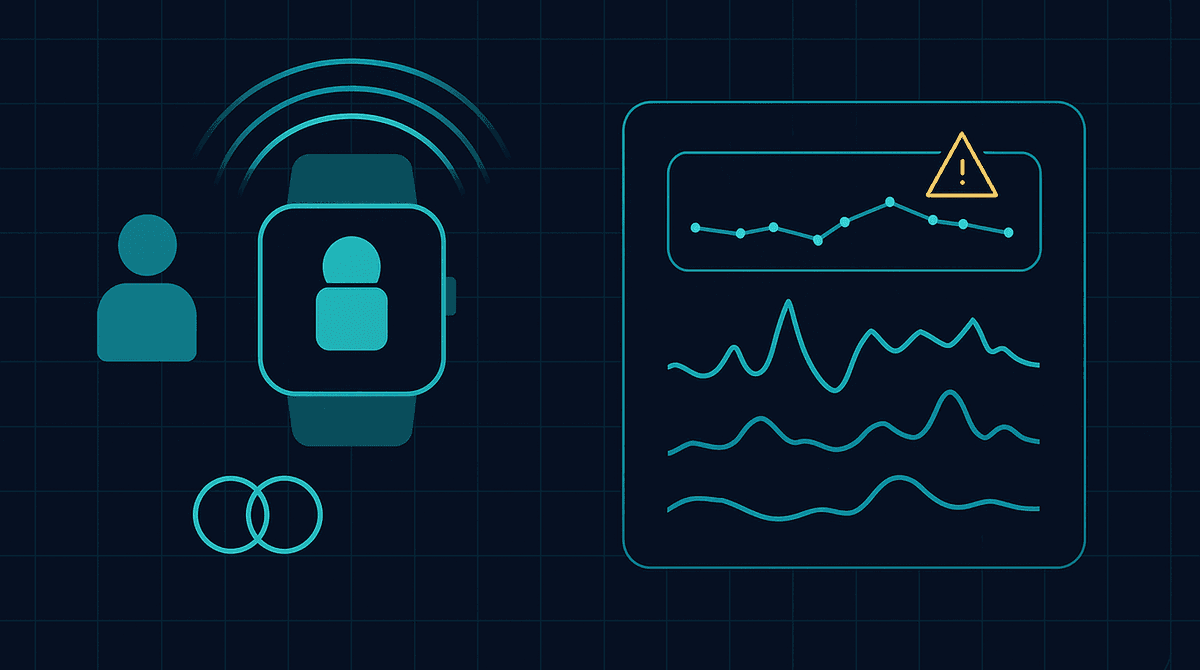
Emotion detection wearables can estimate parts of emotional physiology, especially arousal and stress-related changes, but they cannot directly read feelings from the body. PPG helps because it tracks pulse timing and blood volume dynamics linked to autonomic activity, yet it fails when companies present a noisy cardiovascular signal as if it were a precise label such as anger, joy, or sadness without context or other sensors.
Emotion detection wearables are one of the most overclaimed areas in digital health. Product pages and investor decks often imply that a wristband, ring, or smartwatch can watch the body and determine what a person feels in real time. The underlying science is more restrained. Most wearable systems are not measuring emotion directly. They are estimating physiological changes that may be associated with emotional processes.
That distinction sounds small, but it changes everything. Emotion is not just a body signal. It includes context, interpretation, memory, social meaning, expectation, and behavior. A person may show higher heart rate and lower short-term variability during fear, mental effort, public speaking, intense concentration, excitement, pain, heat exposure, or after climbing stairs. The wearable sees the body response, not the meaning behind it.
Photoplethysmography, or PPG, sits at the center of many of these claims because it is already built into consumer devices. Optical sensors can estimate pulse-related metrics continuously with low cost and low power. That makes PPG attractive for any company trying to turn physiology into a daily emotional dashboard.
If you want background on the signal itself, our guide to PPG emotion recognition covers why pulse-derived features appear so often in this field. Our article on whether a smartwatch can detect stress is also useful, because stress scoring is often where wearable vendors begin before expanding into broader emotion language.
Why PPG became the default sensor for emotion wearables
PPG has a practical advantage that other biosignals do not. It is easy to embed in a watch or ring, people are already used to it for heart rate tracking, and the hardware stack is mature. From the waveform, developers can estimate heart rate, inter-beat intervals, pulse rate variability, pulse amplitude trends, and signal morphology features that may reflect vascular and autonomic changes.
Those features matter because emotional processing often involves the autonomic nervous system. When sympathetic activation rises, cardiovascular patterns can shift. When a person recovers, pulse dynamics can shift again. That gives researchers and product teams a measurable pathway into state estimation.
This is the honest part of the story. PPG can be useful for identifying physiological activation, changes from baseline, and patterns that align with stress, effort, recovery, or arousal. In controlled studies, it can also contribute to machine learning models that separate broader emotional dimensions such as high versus low arousal, or positive versus negative valence under specific tasks.
Where teams get into trouble is when they move from "PPG contributes useful physiological information" to "our device knows what you feel." That second claim is much harder to defend.
What PPG actually measures
PPG is an optical method that tracks changes in light absorption caused by blood volume fluctuations in tissue. In wearables, green or infrared LEDs illuminate the skin, and the sensor estimates reflected light changes tied to the cardiac cycle. The raw signal is then filtered and transformed into features.
That means PPG is not a direct emotion sensor. It is a cardiovascular proxy. It can reflect autonomic activation, vascular tone shifts, and pulse timing changes, but it does not observe cognition, appraisal, speech content, environment, or intention. Those missing layers matter because emotion is not reducible to a pulse waveform.
A useful mental model is this: PPG can tell you that the body seems more activated, less stable, or slower to recover. It usually cannot tell you why with high confidence unless the system has additional information.
Where emotion wearables start to overpromise
The overpromise usually appears in three places: labeling, generalization, and confidence.
Labeling problems
A model may be trained on participants watching stimulus clips, listening to sounds, or completing stress tasks. If pulse-derived features shift during those trials, the system may learn a pattern associated with the study label. But once the model is deployed outside that protocol, the same physiological pattern can arise for many reasons. A smartwatch cannot assume that elevated activation means fear instead of excitement, irritation, caffeine, or fast walking.
This is why discrete emotion claims are harder than arousal claims. High arousal is a broad physiological state. Anger is an interpretation. Joy is an interpretation. Embarrassment is an interpretation. The body may help inform those experiences, but it does not uniquely identify them.
Generalization problems
Research performance often comes from controlled collection. Participants may be seated, stimulus timing is known, signal quality is reviewed, and poor segments are excluded. Consumer wearables operate in very different conditions. People gesture, commute, type, exercise, sweat, wear devices loosely, and live in lighting and temperature conditions that the study did not reproduce.
PPG is vulnerable to motion artifact and contact quality issues. Wrist placement, skin properties, sensor pressure, and sampling strategy all affect what is recoverable from the waveform. That is one reason the gap between a paper result and an all-day consumer feature can be wide. We discuss that gap more directly in our comparison of clinical grade and consumer wearables.
Confidence problems
Even when a model is directionally useful, vendors may display a confident emotional score with no uncertainty signal. That is a design problem as much as a modeling problem. If motion artifact is high, if the user is exercising, or if the pattern overlaps with several possible causes, the correct output may be "low confidence" or "state unclear." Many products do not say that because certainty sells better than ambiguity.
Where PPG genuinely adds value
Despite the hype, PPG does contribute real value when it is used for the right target.
1. Arousal detection
PPG is often strongest when the question is whether the body is shifting away from baseline. Changes in pulse timing, variability, and amplitude can help indicate that autonomic activation is rising or falling. This can be useful in stress research, workload monitoring, and emotionally evocative tasks where broad state change matters more than a perfect label.
2. Recovery and regulation tracking
Many wearable systems are more credible when they focus on recovery, strain, or regulation rather than emotion naming. A device may not know that you feel overwhelmed, but it may detect that your cardiovascular pattern has stayed activated longer than your recent norm. That can still be actionable.
3. Within-person monitoring
Population models struggle because physiology differs across age, fitness, medication use, hydration status, circadian rhythm, and baseline autonomic balance. PPG becomes more useful when the model learns the individual. For a given user, the device may notice that certain meetings, travel days, or sleep-deprived periods produce a recurring activation pattern. That kind of personalized trend detection is often more valuable than a universal emotion label.
4. Multimodal fusion
This is the strongest role for PPG in both research and advanced product design. PPG works best as one part of a multimodal stack. Add accelerometry, skin temperature, respiration, electrodermal activity, voice markers, or contextual inputs, and the model can resolve more uncertainty. Motion data can help rule out exercise. Context can show whether the event occurred during a presentation, commute, or workout. Self-report prompts can improve labels over time.
In other words, PPG often supports emotion-aware computing better than it supports standalone emotion reading.
Consumer wearables versus research wearables
The difference between consumer and research systems is not just sensor quality. It is also the problem each system is trying to solve.
Consumer wearables are built for comfort, battery life, price, and all-day acceptance. Research wearables are built for clean data, protocol control, annotation quality, and hypothesis testing. A research team can place a sensor carefully, control task timing, discard noisy segments, and analyze only windows that meet quality thresholds. A consumer device has to work while the user walks to the train, adjusts the strap, or takes the device off and on during the day.
That difference explains why emotion detection claims should always be matched to collection conditions. A result obtained during seated lab tasks is not meaningless, but it should not be translated into a promise that the same classifier will reliably interpret daily emotional life from the wrist.
It also explains why some research wearables appear more persuasive. They often use multiple sensors, richer annotation, and tighter experimental design. In those settings, PPG may meaningfully improve model performance. The mistake is assuming that PPG alone deserves the credit or that a consumer device can reproduce the same conditions without tradeoffs.
Why ground truth is harder than it looks
A hidden problem in emotion wearable research is that labels themselves are imperfect. Some studies rely on self-report after each task block. Others use stimulus type as a proxy label. Some reduce the task to valence and arousal because those dimensions are easier to reproduce than fine-grained emotional categories.
None of this makes the research invalid. It simply means the target is noisy. If the "true" label is partly subjective, delayed, or dependent on wording, model performance will be bounded by that uncertainty. That is another reason why broad state estimation can be more defensible than claiming a device can identify a discrete emotion with precision.
What good validation should look like
When a company markets emotion detection wearables, three validation questions matter.
First, what exactly is being predicted? If the answer is stress load, arousal state, or deviation from baseline, that is clearer than a vague claim about emotion.
Second, what data conditions were used? Was the system tested during controlled tasks, free-living conditions, exercise, or mixed daily use? A model that works only during low-motion seated periods should not be sold as an always-on emotional interpreter.
Third, how is uncertainty handled? Strong systems should flag low-quality windows, report confidence, or avoid overlabeling ambiguous states. If every moment produces a confident emotional score, that is a warning sign.
What better products will probably do instead
The most credible future devices will likely stop pretending to read inner feelings directly. Instead, they will estimate physiological state with clearer language, such as:
- elevated autonomic activation
- lower-than-usual recovery from your baseline
- pattern resembles prior high-demand periods
- low confidence because signal quality is reduced
That approach is less flashy, but it is more scientifically aligned. It also fits how clinicians, researchers, and careful builders already think about wearable physiology. The goal is not mind reading. The goal is useful state estimation with known limits.
The practical takeaway
PPG matters in emotion detection wearables because it offers scalable access to cardiovascular signals that reflect autonomic shifts. That is a meaningful contribution. It becomes misleading when vendors treat those shifts as direct proof of a named emotion.
So where does PPG work? It works for arousal-related tracking, trend detection, recovery monitoring, and as a component in multimodal inference. Where does it fail? It fails when it is asked to infer rich emotional meaning from a single noisy signal in uncontrolled daily life.
If you see a wearable claiming it can tell exactly how you feel from wrist optics alone, pause. The more believable story is narrower and more useful: PPG can help measure how your body is responding, especially when paired with context and other sensors, but it is not a standalone emotion reader.
FAQ
Can PPG directly detect emotions?
No. PPG does not directly detect emotions. It measures pulse-related blood volume changes that may reflect autonomic activation, which is only one component of emotional experience.
Is PPG better at detecting arousal than specific emotions?
Yes. Broad shifts in arousal or stress-related physiology are generally easier to support with PPG than precise labels such as anger, happiness, or sadness.
Why are emotion scores from consumer wearables often overstated?
Because product messaging often compresses a probabilistic physiological estimate into a simple emotional label. That makes the output sound clearer than the signal really is.
Do research wearables use PPG differently from consumer devices?
Often, yes. Research systems usually collect data under more controlled conditions, may combine multiple sensors, and can exclude poor-quality segments before analysis.
Does adding more sensors improve wearable emotion monitoring?
Usually. Motion, temperature, respiration, electrodermal activity, voice, and contextual data can all help explain whether a PPG change is likely tied to emotion, exercise, workload, or something else.
Should users trust a smartwatch that says it knows how they feel?
Users should treat that kind of score as a rough indicator, not as ground truth. It may point to a change in physiological state, but it does not reliably capture the full meaning of emotion.
References
Frequently Asked Questions
- Can PPG directly detect emotions?
- No. PPG does not directly detect emotions. It measures pulse-related blood volume changes that may reflect autonomic activation, which is only one component of emotional experience.
- Is PPG better at detecting arousal than specific emotions?
- Yes. Broad shifts in arousal or stress-related physiology are generally easier to support with PPG than precise labels such as anger, happiness, or sadness.
- Why are emotion scores from consumer wearables often overstated?
- Because product messaging often compresses a probabilistic physiological estimate into a simple emotional label. That makes the output sound clearer than the signal really is.
- Do research wearables use PPG differently from consumer devices?
- Often, yes. Research systems usually collect data under more controlled conditions, may combine multiple sensors, and can exclude poor-quality segments before analysis.
- Does adding more sensors improve wearable emotion monitoring?
- Usually. Motion, temperature, respiration, electrodermal activity, voice, and contextual data can all help explain whether a PPG change is likely tied to emotion, exercise, workload, or something else.
- Should users trust a smartwatch that says it knows how they feel?
- Users should treat that kind of score as a rough indicator, not as ground truth. It may point to a change in physiological state, but it does not reliably capture the full meaning of emotion.