Can a Camera Measure Oxygen Saturation?
Can a phone or webcam estimate SpO2? A practical look at what camera-based oxygen saturation can do today, where it fails, and why heart rate is much easier than oxygen saturation.
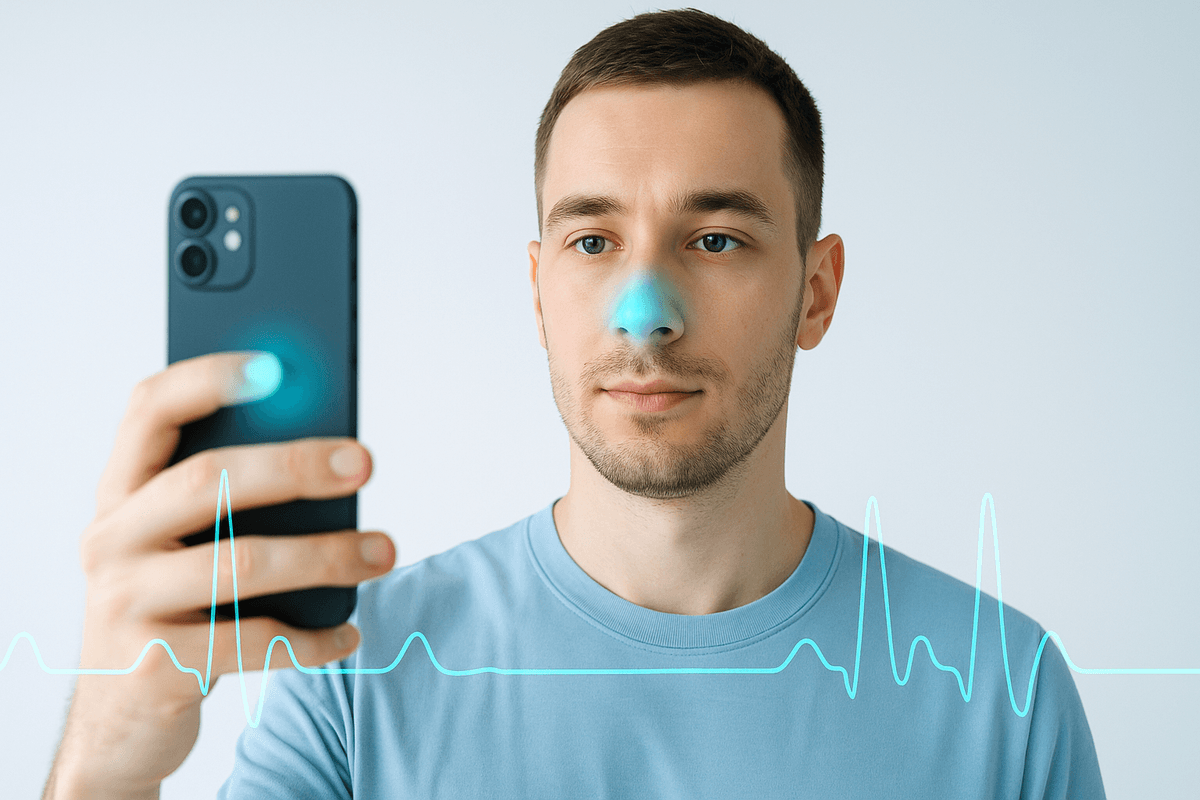
A camera can sometimes estimate oxygen saturation in research settings, but an ordinary phone or webcam should not be treated like a clinical pulse oximeter. If SpO2 matters for triage or care decisions, use a validated finger sensor instead of trusting a face video.
That answer frustrates people because camera heart rate has become pretty good. It creates the illusion that oxygen saturation should be the next easy step. It is not. SpO2 is a much harder measurement problem, and pretending otherwise is how you end up with bad product claims and unsafe workflows.
Why Heart Rate Is Easy Compared With SpO2
Heart rate is basically a timing problem. If the camera can detect periodic blood-volume changes, the software can count beats.
Oxygen saturation is different. Pulse oximetry depends on the ratio of light absorbed at different wavelengths by oxyhemoglobin and deoxyhemoglobin. That is why conventional pulse oximeters use red and infrared emitters plus a calibrated photodetector. The device is built around that optical problem.
A webcam or phone selfie camera is not built for that job.
That does not mean camera-based SpO2 research is fake. It means the measurement stack is stacked against you from the start.
If you want the physics background, our green vs red vs infrared PPG guide is the right foundation. For home-monitoring context, see PPG ambulatory oxygen saturation monitoring and contactless vital signs in telehealth.
How Conventional Pulse Oximetry Works
A standard pulse oximeter shines red light around 660 nm and infrared light around 940 nm through or into tissue. It then isolates the pulsatile arterial component and uses a calibration curve to map the red-to-infrared ratio into an SpO2 estimate.
That sounds simple on paper, but several things have to go right:
- stable contact with tissue
- known wavelengths
- known detector response
- enough perfusion
- minimal motion
- validated calibration across people and use cases
Chan and colleagues laid out these pulse oximetry basics clearly years ago, including why poor perfusion, motion, dyshemoglobins, and optical noise distort results (DOI: 10.1016/j.rmed.2013.02.004). Luks and Swenson later emphasized the same issue in home monitoring: even standard pulse oximeters can mislead if patients use them badly or interpret them without context (DOI: 10.1513/AnnalsATS.202005-418FR).
If dedicated pulse oximeters have pitfalls, imagine how much sloppier the problem gets when you replace the optics with a consumer camera pipeline tuned for selfies and video calls.
Why Ordinary Cameras Struggle
RGB channels are not the same as red and infrared pulse oximetry
Phone and webcam sensors capture broad red, green, and blue bands. Those are not precise substitutes for a clinical pulse oximeter's red and infrared emitters. Even when a camera sees a "red" channel, you do not have the same wavelength control, optical path, or calibration.
Automatic exposure and compression get in the way
Consumer cameras constantly adjust white balance, exposure, gain, and noise reduction. Video platforms may also compress the stream. Those operations are great for making faces look decent on screen. They are bad for extracting subtle oxygen-related optical changes.
Motion hurts more
Heart-rate algorithms can often survive some movement because they only need the dominant periodic signal. SpO2 estimation depends on smaller differential signals between channels. Motion can overwhelm that difference very quickly.
Skin, lighting, and perfusion matter a lot
All optical measurement depends on how light enters and exits tissue. Differences in lighting, makeup, facial hair, perfusion, and camera angle change the signal. So do vasoconstriction and cold hands or cold skin.
Bent et al. showed how wearable optical sensors run into accuracy problems under motion and real-world variability (DOI: 10.1038/s41746-020-0226-6). Those same real-world factors do not disappear just because the sensor moves off the skin and onto a webcam.
What the Camera-Based SpO2 Evidence Actually Says
The honest summary is this: there is research promise, but clinical reliability is still weak.
Some camera-based vital-sign platforms report useful SpO2 estimation under controlled lighting and carefully selected patient groups. Amelard et al. found that contactless camera measurement can achieve acceptable performance for some vital signs, but not consistently across all subgroups or conditions, and limitations become more obvious as the measurement target gets more demanding (DOI: 10.1038/s41746-022-00606-z).
That aligns with what most serious teams in the field already know. Heart rate and respiratory rate are the first commercial wins. Blood pressure and oxygen saturation are where vendor decks get much more ambitious than the evidence.
This is also why you see a lot of vague wording in product materials. "Wellness insights." "Oxygen trend estimation." "Contactless health signals." Those phrases exist because saying "clinical-grade SpO2 from any webcam" would be reckless.
Can a Phone Camera Ever Do It?
Maybe, in a narrow sense.
A phone camera can be used in a tightly designed research workflow to estimate oxygen-related features. A specialized system may add controlled lighting, device-specific calibration, fixed distance, and strong signal rejection. In those conditions, you can get interesting outputs.
But that is not the same as saying the average consumer can open a selfie camera in a dim bedroom and obtain a trustworthy oxygen saturation reading.
That distinction matters. Too many discussions about camera SpO2 collapse lab feasibility into real-world product readiness.
Where Camera-Based Oxygen Saturation Might Be Useful
There are a few realistic near-term roles.
1. Screening or prioritization
A system could flag that the signal looks concerning or that a proper pulse oximeter reading is needed.
2. Multimodal models
A camera-derived oxygen estimate may become more useful when combined with symptoms, heart rate, respiratory features, or waveform quality. It may support risk scoring even if it is not trusted as a standalone SpO2 number.
3. Environments where no hardware is available yet
In low-friction digital intake, a rough oxygen-related feature might be better than nothing, as long as the product is honest that it is not a pulse oximeter.
These are careful use cases. None justify replacing standard pulse oximetry when hypoxemia is the clinical question.
Where It Should Not Be Used Alone
If a patient has shortness of breath, suspected pneumonia, COPD exacerbation, sleep-related desaturation, or possible post-op respiratory compromise, camera-only SpO2 is the wrong tool.
Use a validated pulse oximeter.
That is especially true in home monitoring. Lipnick et al. found that even inexpensive fingertip pulse oximeters vary meaningfully in accuracy, which should make everyone more cautious, not less, about weaker optical substitutes (DOI: 10.1213/ANE.0000000000001300).
For clinical teams, the better architecture is usually straightforward:
- use camera methods for low-friction heart rate and maybe respiratory rate
- use a validated oximeter when oxygen saturation matters
- merge the data into one RPM or telehealth workflow
That is less flashy than saying the camera does everything. It is also much closer to reality.
A Better Buyer Question
Instead of asking a vendor, "Can your camera measure oxygen saturation?" ask this:
Under what exact conditions, with what error, in which population, and what is your backup plan when the signal is weak?
If the answer is vague, you already know what is going on.
Good vendors will tell you where the system works, where it does not, and when a hardware oximeter is still required. Bad vendors will hide behind AI branding and general claims about remote vitals.
My Take
Right now, camera-based SpO2 is interesting science and selective product support, not a dependable replacement for pulse oximetry.
Could that change? Sure. Better multispectral sensors, better calibration, better fairness testing, and tighter workflow control could improve things. But that is a future roadmap, not a permission slip to skip hardware today.
So can a camera measure oxygen saturation?
Technically, sometimes.
Can a normal phone or webcam be trusted like a clinical pulse oximeter? No. Not yet, and in many real-world workflows, not even close.
References
- Chan ED, Chan MM, Chan MM. "Pulse oximetry: understanding its basic principles facilitates appreciation of its limitations." Respiratory Medicine 107(6) (2013). DOI: 10.1016/j.rmed.2013.02.004
- Luks AM, Swenson ER. "Pulse oximetry for monitoring patients with COVID-19 at home: potential pitfalls and practical guidance." Annals of the American Thoracic Society 17(9) (2020). DOI: 10.1513/AnnalsATS.202005-418FR
- Lipnick MS, Feiner JR, Au P, et al. "The accuracy of 6 inexpensive pulse oximeters not cleared by the Food and Drug Administration." Anesthesia & Analgesia 123(2) (2016). DOI: 10.1213/ANE.0000000000001300
- Amelard R, et al. "Feasibility of camera-based vital signs measurement in clinical populations." npj Digital Medicine (2022). DOI: 10.1038/s41746-022-00606-z
- Bent B, Goldstein BA, Kibbe WA, Dunn JP. "Investigating sources of inaccuracy in wearable optical heart rate sensors." npj Digital Medicine 3 (2020). DOI: 10.1038/s41746-020-0226-6
Frequently Asked Questions
- Can a regular phone camera measure oxygen saturation?
- Not reliably enough for clinical use. Research systems can estimate oxygen saturation in controlled settings, but ordinary phone cameras are still a poor substitute for a real pulse oximeter.
- Why is SpO2 harder than camera heart rate?
- Heart rate only needs a clean pulse waveform. SpO2 depends on wavelength-specific light absorption, calibration, perfusion, and a much tighter error budget.
- Can a webcam estimate oxygen saturation during telehealth?
- Sometimes as an experimental signal, not as a dependable clinical measurement. Lighting, motion, skin exposure, and camera compression all create problems.
- Do infrared sensors matter for oxygen saturation?
- Yes. Conventional pulse oximetry relies on red and infrared wavelengths, which is a big reason ordinary RGB webcams struggle.
- Is camera-based SpO2 good enough for home triage?
- Not on its own. If oxygen saturation matters, use a validated finger pulse oximeter.
- What can a camera do better than SpO2 today?
- Heart rate, respiratory-rate estimation, and some signal-quality or perfusion-related screening tasks are much more realistic today than oxygen saturation.